
As people ask and search for answers online, they often subconsciously ask themselves,
“Is this human-written or AI-generated content?”
This is mainly because AI-generated content has populated many blogs/websites, and in fact, Google itself. While some are well-researched, generated, and optimized, others are filled with jargon and outdated facts or statistics. This alone makes people doubt the authenticity of the information they find online, especially when they are not conversant with the website.
But here’s one thing we all know: the question of which performs better, AI content vs human content, is tied to the core value of its:
- Authenticity
- Ability to connect with the reader
- Build trust
- And demonstrate genuine expertise.
In this guide, we will look at the comparison between AI content and human content, using excerpts from data, and use cases like how RankPilot helped BlueSkyHunter rank on Google and ChatGPT, so that, as a digital marketer, business owner, Agency, or solopreneur, you can easily find the approach that suits your goals.
What is AI-generated content?
AI content is essentially any content, such as text, images, videos, etc., generated using machine learning models, including GPT (Generative Pre-trained Transformer) models like ChatGPT, Claude, and Gemini, which are trained on billions of datasets. One of the unique features of these AI tools is their speed in generating content such as articles, product descriptions, social media posts, or images on any given prompts and keywords.
Specialized AI Tools for Content Writing
While most of the AI models like ChatGPT generate easy-to-identify AI content, there are specialized AI tools that use natural language processing to produce content that mimics human writing patterns, ensuring the content is authentic and connects to the reader naturally. Some of these AI tools using NLP (Natural Language Processing) are RankPilot.
Key Features of the Most Common AI Content
- Speedy content generation
- Consistent tone and formatting across all AI tools
- Data collection from multiple sources simultaneously
- It is scalable at no cost
- Generic or repetitive
- It has limited depth in emotions and personal experience
- Risk of factual inaccuracies if not properly checked by humans
What is a Human Written content?
On the other hand, human-written content is any content that is produced by means of writing by humans, rather than being generated by AI. These include blogs, social media posts, product descriptions, documentation, books, poems, news, whitepapers, etc. This content is often unique, drawn from experience, authentic, and easily connects to the readers (when written well).
It’s just like when a content marketer writes about the challenges they experienced when launching a campaign or a business owner shares their entrepreneurial lessons, they write more authentic content with real experiences that naturally resonate with their readers.
Key Features of Home Written Content
- Original insights from personal or professional experience
- It emotionally resonates with the readers
- It is culturally sensitive
- There is intentional consistency in brand voice (for brands)
- It applies ethical judgment to sensitive topics
What is Hybrid content?
Hybrid content is a combination of both AI-generated content and human-written content. It combines the use of AI tools to create drafts or generate some sections of the content, while a writer drafts the other sections of the article.
Basically, hybrid content combines the characteristics of both AI content and human content to produce content at a faster pace, compared to a writer manually writing it, and infusing the human emotion and authenticity that human content has.

Comparison Table of AI Content vs Human Content
| Aspect | Basic AI Content Tools | Human Content Advantages | AI Content with Specialized Tools (e.g., RankPilot) |
| Speed & Scale | It instantly generates a large volume of content | It is slower, but it’s creative, personalized, and includes storytelling | It’s also fast; it can integrate trending data and multiple formats instantly |
| Accuracy & Context | It may miss nuance; it basically relies on existing data | It excels at context, nuance, and integrating the latest trends | It can pull in live data, use a schema, and avoid outdated/incorrect info with built-in fact-checking |
| SEO Optimization | It can optimize keywords, meta, and structure | It uses more natural keywords and increases engagement | It is optimized for both search engines and AI platforms (e.g., ChatGPT, Gemini), and uses industry-based and intent-driven SEO signals |
| Cost Efficiency | It is up to 4-5x cheaper than humans; scalable | It has a higher cost per piece of content, and it’s time-intensive | It is 50-75% lower cost than human-only; fast at scale, reduces research time |
| User Trust & Authenticity | The content may feel robotic, generic, or untrustworthy | The content often builds trust, authority, and emotional connection | It builds higher trust because it combines expert data, relevant backlinks, E-E-A-T, and emotional connection. |
| Search Rankings | It ranks well if the content is comprehensive and high quality; it may drop off without E-E-A-T | It holds ranking longer, and it’s rewarded for depth and originality | It ranks on Google and LLMs like ChatGPT. It is really helpful, especially for newer sites that want to leverage schema and LLM optimization |
Characteristics of AI Content vs Human Content
Search Engine Rankings and Organic Traffic
The question “Does AI content rank on Google?” is one of the top questions often asked by content marketers, SEO professionals, business owners, and agencies managing clients’ websites, as everyone quests for sustainable organic growth online.
This question has led to a good number of assumptions about AI vs. manual content writing. But according to research conducted in 2024 by Search Engine Journal, they analyzed a good number of AI-generated articles. It was discovered that AI-assisted content ranked comparably to human-written content when they met certain quality standards. These standards include:
- The depth of the content and how comprehensive it is: If the article covers relevant aspects of the topic, it generally performs 40% better, regardless of how it was created (whether generated by AI or written by a human)
- If it contains original data and insights: Any content that includes original research data or insight, and offers a unique perspective, is said to have better ranking potential
- Contains E-E-A-T signals: The articles that have author credentials, citations, and show expertise in the subject matter ranked higher across both AI and human content categories.
- User engagement metrics: Metrics such as visitors’ time on page and low bounce rates were also used to determine ranking compared to whether the article was AI-generated or human-written.
This shows that the ranking of content is not primarily determined by whether it is written by a human or AI. It is determined by several factors; hence, if you can achieve a good ranking with AI content, it is important to use specialized AI SEO tools that better optimize your content for search engines and human engagement.
An example of a tool like this is RankPilot. Further in this article, we will be looking at how Blueskyhunter used RankPilot to draft an article that helped them rank on Google and ChatGPT.
Conversion and User Engagement Rates
Aside from ranking metrics, the performance of AI vs human content can be determined by other metrics such as engagement rates of readers, and also the conversion the content generates based on what it’s intended for (newsletter signups, sales, subscriptions, etc.)
When it comes to gauging metrics like engagement, it is often where you hear people asking questions like “Can AI truly replace human creativity?”
According to a survey by Databox, on 140+ businesses based on the impact of using AI content, the following insights were highlighted:
- Blog content: Informational/educational articles generated with AI showed 15-20% lower average time on page compared to human-written content. This was suggested to be mostly due to generic content, which had a very low quality of engagement.
- Product descriptions: The survey revealed that AI-generated descriptions, which were edited by a writer (hybrid content), had an 87% conversion rate over the rate of human content. This alone reduces the content writing/production time by 75%.
- Landing pages: It was discovered that AI-generated landing page copy converted 31% worse than human-written copy. This can be attributed to using non-specialized AI that creates generic content without effectively adopting the brand tone, resonating with the target audience, and addressing their pain point.
- Email campaigns: It was also noted that subject lines generated by AI performed 23% better in open rates than human-written subject lines. It was suggested to be likely due to AI’s ability to A/B test patterns at scale.
The data and insights from this survey show that AI content vs human content performance varies significantly by content type and use case. Transactional content like that for landing pages tilts towards human-written content, while those for product description favor hybrid content that combines both AI and Human expertise.
This analysis has further shown how the use of specialized AI tools for better performance is needed to address both the weaknesses of basic AI content and human content.
Social Media Content Performance and Virality
Let’s also have a look at the performance and virality of social media AI content vs human content. According to the research by BuzzSumo, which analyzed over 100,000 social media posts across LinkedIn, Twitter, and Facebook, categorizing them by the creation method (AI vs human). Below are some of the insights from this analysis:
- AI-generated posts had comparable reaction (likes) counts when using trending topics to gauge their performance
- Posts that combine AI research with human storytelling performed 67% better than pure AI content
- Human-written posts generated 2.4x more comments on average
- Video content scripts written by humans outperformed AI scripts by 89% in watch-time completion
- AI-generated LinkedIn posts received 40% fewer shares than human-written content.
What was inferred from these insights is how AI content falls short of infusing emotional human connection in its content because it was basically generic without naturally connecting with the target audience.
A Case Study of How BlueSkyHunter Used RankPilot to Rank ChatGPT Results
One of the most interesting examples of AI-generated content performance comes from BlueSkyHunter, a social media growth tool for BlueSky.
When BlueSkyHunter used RankPilot to generate SEO and LLM-optimized content, they achieved something many content and digital marketers struggle with: getting featured in ChatGPT search results.
What was BluSkyHunter Struggling with?
BlueSkyHunter needed to establish authority in the emerging Bluesky Social niche. With limited resources and competing against established social media management tools like Hootsuite, they needed a scalable content strategy that would work across both traditional search engines and LLMs like ChatGPT.
How RankPilot Helped BlueSkyHunter
Rather than manually writing dozens of generic articles about Bluesky growth strategies, tools, and best practices, BlueSkyHunter leveraged RankPilot’s automated content generation with several key elements:
- The content included current Bluesky trends and tool comparisons
- The article had proper schema markup and clear information hierarchies
- The article referenced authoritative sources and included comparative data
- It provided an in-depth analysis of the topic rather than surface-level keyword targeting
- Optimized content for LLMs.
The Result of BlueSkyHunter Using RankPilot for Content Creation
After creating and automatically publishing the content for BlueSkyHunter, when the target audience searches and asks ChatGPT questions like “what’s the best tool for Bluesky growth?”, BlueSkyHunter appeared as a featured recommendation alongside established tools like Hootsuite, BlackTwist, and Swat.io. The AI-generated content achieved several critical outcomes:
- First, LLM visibility: BlueSkyHunter was featured in ChatGPT responses for competitive queries in the social media management space.
- Second, authority signals: The tool was positioned alongside premium, established brands despite being newer to the market.
- Third, detailed features brief: ChatGPT provided comprehensive information about BlueSkyHunter’s features, including analytics, scheduling posts, discovering trending content, automating DMs, and engagement tools.
- Finally, highlighting credibility: Being cited by AI assistants enhanced brand perception and drove qualified traffic to BlueSkyHunter.
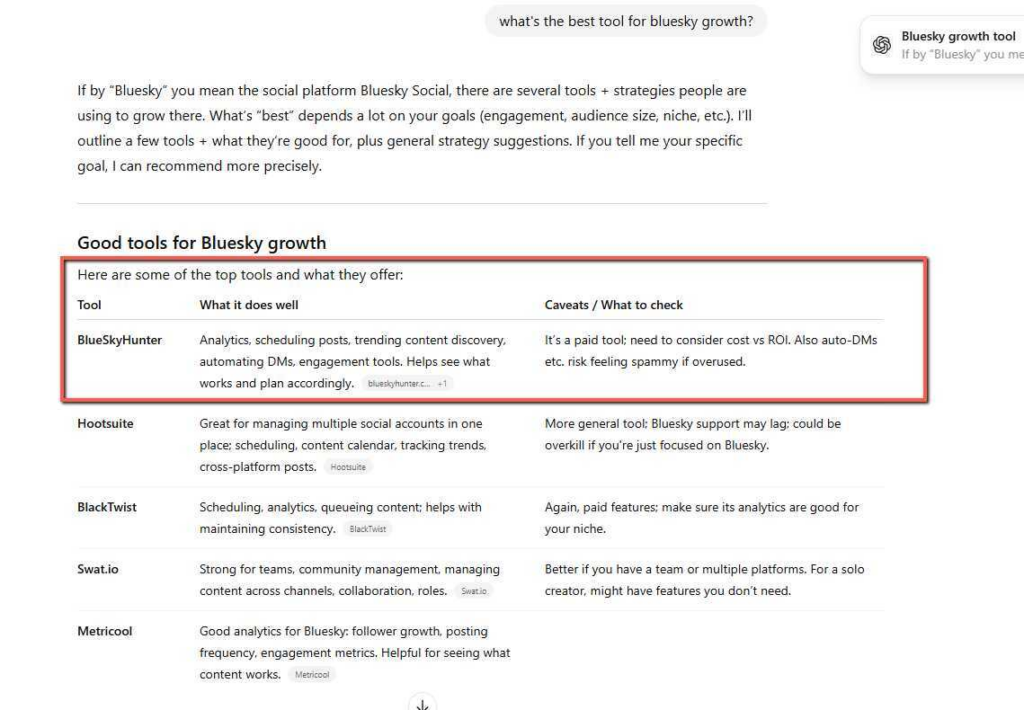
The Impact of Using AI Tools like RankPilot by BlueSkyHunter in Deciding Which Performs Better: AI Content Vs Human Writing?
This case study shows that AI-generated content, when properly optimized, can compete for visibility not only in traditional search engines like Google or Bing but also in LLMs’ responses like ChatGPT, Claude, etc.
The key factors that made this successful are primarily what perform well in traditional SEO, but with added emphasis on facts, accuracy, and comprehensive description of BlueSkyHynter features, clear value propositions, and structured data/information that is easy for AI systems to parse and present.
For businesses wondering whether AI content vs human content performs better, especially in the LLM landscape, especially as a lot of search is now done on ChatGPT and the likes, BlueSkyHunter’s success shows a clear answer, which is: properly optimized AI content can achieve visibility that drives business results, especially when using platforms like RankPilot that specifically optimize for both traditional search engines and AI assistants.
This gives a significant advantage for small and medium-scale businesses. Rather than spending months manually creating content and building authority, RankPilot’s automated approach helps with rapid market entry, visibility, and growth in both Google search results and AI tools’ responses.
What’s Better: AI Content or Human Content?
The answer to the question, “what’s performing better?” between AI content and human content is no longer a guesswork. The data and analysis in this article reveal that neither approach dominates across all contexts and metrics. Instead, performance depends on content type, business goals, audience expectations, quality, and the use of specialized SEO tools.
Specialized AI SEO tools RankPilot can generate daily SEO and LLM-optimized content with built-in credibility signals, relevant backlinks, schema markup, and real-time research.
This addresses the weaknesses of basic AI content and human errors, especially for small businesses, digital marketers, and agencies that face high SEO costs (typically $500+ monthly for multiple SEO tools), time-consuming content strategy, and the complexity of optimizing for both traditional search engines and AI platforms like ChatGPT.
Leave a Reply