Author: Borut

  • Why Your E-commerce Store Isn’t Ranking (The 5 Mistakes I See Constantly)

    Why Your E-commerce Store Isn’t Ranking (The 5 Mistakes I See Constantly)

    According to research, over 93% of internet users start their buying journey by searching the internet, e.g, Google, AI models like ChatGPT, etc.

    This means there is a lot of potential for e-commerce businesses to get significant traffic and conversions when someone sees their products as a recommendation easily, without flipping through a number of pages on search engines. 

    Now get this:

    Being easily found on search engines or recommended by ChatGPT is not subject to having the best products (in fact, your best competitor might have the worst product but ranks on Google’s first page).

    So why your E-commerce store isn’t ranking is because you are making some preventable SEO mistakes, because even as people increasingly search on AI Models, like ChatGPT, SEO remains the basics for optimizing your store or product recommendation on generative AI models.

    In this article, we’ll walk through the five most common e-commerce SEO mistakes I see constantly, and more importantly, how to fix them. When you do this correctly, SEO will organically bring people who are actively searching for exactly what you are selling directly to your product pages. This will reduce your need to run ads on search engines.

    5 Reasons Why Your E-commerce Store Isn’t Ranking (And How to Fix Them)

    1. Thin and Duplicate Content

    Among the many reasons e-commerce websites don’t rank, one that is often a content problem is specifically duplicate content and thin content. 

    What is Duplicate Content?

    Duplicate content is when you have identical content or very similar content appearing on multiple pages of your website or across different websites. 

    This typically happens on e-commerce stores when you copy the manufacturer descriptions or the same product description from another store, word-for-word, across your product pages. If you’re selling the same items as dozens of other retailers and using the same generic descriptions, Google sees your content as duplicated and won’t often rank it.

    It’s just like when 27 stores all have the same product description for a microwave. Won’t Google show all 27 results? It picks the most authoritative website (usually the manufacturer or a major retailer) and ignores the rest. So, your new store doesn’t stand a chance.

    What is Thin Content?

    Thin content content on the other hand, is not better. It is equally problematic. It refers to pages with very little useful information, like just a product title, price, and a three-sentence description. This is mostly seen in category pages that often display only a grid of products with no context or helpful information for shoppers.

    Thin and duplicate content negatively affect your SEO because search engines reward websites that provide unique value to users, like helpful and detailed product descriptions.

    When your category or product pages offer nothing different from your competitors or barely answer the searcher’s questions, Google would have no reason to rank you higher or signal to ChatGPT and other AI models that you should be recommended to users.

    How to fix Duplicate and Thin Content on an E-Commerce Website

    The manual thing to do is to rewrite your product and category descriptions from scratch, though it takes time. Add more helpful details that address. 

    • The problems the product solves
    • How is it used
    • Its dimensions and specifications
    • Customer use cases
    • Add unique sections to your product pages, like FAQs
    • Comparison tables between similar products

    This organically helps with SEO, which also increases conversions by addressing your buyer’s concerns before they leave your site.

    To be honest, this is time-consuming, and you might have to start looking for a good SEO writer, costing you to stretch your budget beyond what you intended. RankPilot is one of the auto SEO tools that can help automate the creation of SEO-optimized descriptions and content for both product and category pages. RankPilot generates unique descriptions backed by real-time research and naturally incorporates keywords without you spending hours writing manually or hiring an SEO writer.

    2. Keyword Stuffing and Ignoring Search Intent

    While keywords are really essential in an organic SEO strategy, many e-commerce store owners make two mistakes when using them: they either stuff keywords unnaturally into their content or they completely misunderstand what customers are actually searching for.

    What is Keyword Stuffing?

    Keyword stuffing is basically unnaturally adding your target keywords into content as many times as possible, hoping it will boost rankings. I agree that years ago, this sometimes worked. But today, it’s a fast track to penalties and poor rankings.

    Content that reads like “Buy silver kitchen utensils. Our silver kitchen utensils are the best silver kitchen utensils. Looking for silver kitchen utensils? These silver kitchen utensils are perfect silver kitchen utensils for you” is painful to read and signals low quality to Google.

    One important thing about modern search engines is that they are advanced enough to understand natural language, synonyms, and context. They reward content that flows naturally and comprehensively covers a topic, not content that robotically repeats the same phrases.

    What is Search Intent?

    Search intent is another serious mistake. Even more important than keyword frequency. It refers to the real reason someone types a query into Google. It basically addresses questions like:

    • Are they looking to buy something right now?
    • Are they researching options?
    • Do they need information or a solution to a problem?

    For example, someone searching “best silver kitchen utensils for modern kitchen” has a different intent than someone searching “2026 silver Kenwood kitchen utensils buy now.” The first person is researching and comparing options; the second person is ready to purchase a specific product. If your product page is optimized only for the buying keywords but doesn’t address research queries, you’re missing opportunities to capture potential customers earlier in their journey.

    Many e-commerce stores focus solely on product names and miss out on informational keywords that bring in people who will eventually buy. Creating content that fits different stages of the buyer’s journey helps you rank better and attract the right audience.

    How to Fix Keyword Stuffing and Align Content with Search Intent

    The first thing to do is to stop forcing keywords into your content. Simply write naturally for humans first, then review your content to ensure you’ve included your primary keyword once in the title, and add it naturally throughout the content. Also include related terms or synonyms (latent semantic indexing), which helps search engines understand context.

    Before writing any content, research what people are actually searching for using tools like Answer Socrates, Google’s “People Also Ask” feature, keyword research tools, or simply typing your main product category into Google and seeing what autocomplete suggests. These reveal the questions and concerns your target customers have.

    • Create different types of content for different search intents:
      Product pages should target transactional keywords (“buy,” “price,” “discount”)
    • Blog posts and guides can target informational keywords (“how to choose,” “best for,” “vs comparison”)
    • Category pages work well for navigational searches (“women’s winter jackets”).

    An advantage for e-commerce websites that use RankPilot is that it automatically understands search intent by analyzing Google Search Console data and “People Also Ask” questions to create content that naturally addresses what users want to know. RankPilot generates articles optimized for both Google and AI search like ChatGPT, ensuring your content ranks across multiple channels. For instance, when RankPilot helped BlueSkyHunter improve their visibility, they focused on creating content that matched the target audience’s queries rather than just stuffing product names everywhere.

    The key is thinking like your customer:

    • What would you type into Google if you were looking for your products?
    • What questions would you have before buying?

    Answer those questions clearly and naturally, and the keywords will naturally take care of themselves.

    3. Poor Technical SEO

    Yes, I understand that you may not be a technically knowledgeable person when it comes to SEO, but technical SEO can sound intimidating. However, it’s not rocket science; essentially, it’s about ensuring your website functions smoothly for both visitors and search engines. When your technical foundation is weak, even great content won’t rank well.

    What is technical SEO?

    It basically includes the behind-the-scenes elements that affect how search engines crawl, index, and rank your website. For e-commerce stores, the most critical technical factors include site speed, mobile-friendliness, secure connections (HTTPS), proper URL structure, and the absence of broken links or errors. Let’s briefly look at them.

    Website Speed

    Website speed is essential because slow-loading pages often frustrate visitors and hurt your rankings. Research has consistently shown that pages loading in under two seconds have better conversion rates than slower pages.

    If your product images load very slowly or your website code slows down visitor experience, potential customers will leave before they even see what you’re selling.

    Mobile-Friendliness

    Another non-negotiable is that your e-commerce store is mobile-friendly. Most e-commerce traffic now comes from mobile devices, and Google primarily uses mobile versions of sites for ranking. If your store isn’t optimized for phones and tablets with a responsive design, easy navigation, and clickable buttons, you are likely invisible to the majority of your potential customers.

    Broken Links

    Broken links are another mistake that can curse your traffic and conversion, creating dead ends for both users and search engine crawlers. When visitors click a link and land on a 404 error page, they are more likely to lose trust in your website. When Google’s crawlers meet multiple broken links, they assume your site is poorly maintained and lower your rankings accordingly.

    URL Structure

    Lastly, when it comes to technical SEO, URL structure matters more than most people think. Clean, descriptive URLs like “yourstore.com/womens-running-shoes” are far better than messy ones like “yourstore.com/product?id=12345&cat=8.” Essentially, good URLs help both users and search engines understand what’s on a page before even visiting it.

    How to Fix Technical SEO Issues

    The first thing is to start by testing your site speed using free tools like Google PageSpeed Insights or GTmetrix. These will identify specific problems slowing your site down, like oversized images, unnecessary plugins, or poor hosting. Ensure you always compress your product images using tools like TinyPNG before uploading them, and consider a faster hosting provider if needed.

    Check mobile-friendliness using Google’s Mobile-Friendly Test tool. If you find any issues, work with your e-commerce CMS’s support or a developer to ensure a more responsive design. Most CMS like Shopify, WooCommerce, and Wix offer mobile-responsive themes by default, so ensure yours is activated properly.

    Use Google Search Console (it’s free) to identify broken links and crawl errors. Fix or redirect any broken URLs promptly. Review your URL structure and make sure product and category URLs are short, descriptive, and include relevant keywords naturally.

    It is also important to implement schema markup because structured data helps search engines understand your products better. Schema can show star ratings, prices, and availability directly in search results, which increases click-through rates. 

    Many e-commerce platforms now offer built-in schema support, or tools like RankPilot automatically add schema markup to your content, which ensures search engines and AI platforms like ChatGPT can properly understand and recommend your products.

    Technical SEO isn’t something you fix once and forget. It’s important to regularly audit your store as you add products and content over time.

    4. Neglecting On-Page SEO Elements

    Another mistake is neglecting on-page SEO. On-page SEO basically refers to the elements on your actual web pages that you can optimize to improve rankings. Many e-commerce store owners focus exclusively on adding products and forget to optimize these important elements. Below are these elements:

    Title Tags

    Title tags are some of the most important on-page elements. These are the blue clickable headlines that appear in search results. A good title tag should include your primary keyword, be under 60 characters to display fully, and attract clicks. Yet a good number of e-commerce websites use generic titles like “Product 1” or auto-generated tags that don’t help anyone.

    Meta Descriptions

    Meta descriptions are the short summaries below title tags in search results. While they don’t directly impact rankings, they significantly influence click-through rates. A compelling meta description acts like ad copy, giving searchers a reason to click your result over competitors’. Many stores leave these blank or let systems auto-generate them from random page text.

    Header Tags (H1, H2, H3, etc.)

    Header tags organize your content and help search engines understand your page hierarchy and main topics. Your H1 should contain your primary keyword and clearly state what the page is about. Subheadings (H2, H3) should break content into scannable sections, each focusing on specific aspects of your topic.

    Image Optimization

    Image optimization is frequently overlooked as well, yet it’s important for e-commerce. Product images should have descriptive file names (not “IMG_12345.jpg”) and alt text that describes what’s in the image. This helps visually impaired users, helps images rank in Google Image Search, and gives search engines additional context about your products.

    Internal Linking

    Internal linking at the page level matters too. Linking related products, relevant blog posts, and category pages within your content helps search engines discover and understand relationships between your pages while keeping visitors engaged longer. (more on this later).

    How to Fix On-Page SEO Elements Issues

    The first thing is to start with a title tag audit. Every product page, category page, and content page needs a unique, descriptive title including your target keyword naturally. Format them like:

    • “Product Name – Key Benefit | Brand Name”
    • “Category – Descriptive Phrase | Store Name.”

    Write unique meta descriptions for key pages (prioritize top products and categories first). Keep them under 155 characters, include your keyword once, and create a clear value proposition that encourages clicks. The truth is, a meta description is like your 15-second sales pitch in search results.

    Structure your content with clear headers. Product pages should have an H1 with the product name, then H2s for different sections like “Features,” “Specifications,” “Customer Reviews,” and “Shipping Information.” This makes pages easier to scan and helps search engines extract relevant information.

    Rename your product images before uploading them. Instead of cryptic file names, use descriptive ones like “red-leather-crossbody-bag-front-view.jpg.” Add alt text describing the image for every product photo. Be specific: “Red Italian leather crossbody bag with gold hardware” is better than “bag.”

    Add internal links naturally within your content. If you mention a related product or category, link to it. If you have a blog post about caring for leather goods, link to it from leather product pages.

    Many e-commerce platforms offer plugins or apps that help with on-page optimization. For stores needing a more systematic content creation and optimization, RankPilot automatically optimizes all on-page elements when generating content: properly formatted title tags, compelling meta descriptions, organized headers, and schema markup by default. This ensures every piece of content published follows SEO best practices without manually doing it yourself.

    Lastly, proper on-page optimization signals relevance and quality to search engines. When done with good content, these elements create a strong foundation for higher rankings.

    5. Weak Internal Linking and Site Structure

    Now it’s common when you feel like your website’s structure and how pages link to each other seem like minor technical details, but they significantly impact both SEO performance and user experience. Because a poor site architecture can confuse your visitors and search engines alike, which affects your rankings and conversions

    What is a Site Structure?

    Site structure is basically how your website’s pages are organized and connected. Ideally, an e-commerce store should have a clear hierarchy: homepage at the top, category pages one level down, subcategories (if needed) another level down, and individual product pages at the bottom. This creates a logical flow that’s easy to navigate.

    Many e-commerce stores make the mistake of creating flat structures where everything is randomly connected, or overly deep structures where products are buried five clicks away from the homepage. These kinds of structures make it hard for search engines to crawl your site efficiently and for customers to find what they need.

    What is Internal Linking?

    Internal linking is basically how you connect different pages on your website through hyperlinks. Good internal linking helps search engines discover new pages, understand which pages are most important, distributes ranking power throughout your site, and keeps visitors engaged by guiding them to related content.

    Unfortunately, many e-commerce stores have weak internal linking strategies. Product pages exist in isolation with no connections to related items or relevant blog content. Blog posts about topics related to products never link to those products. And category pages don’t cross-link to complementary categories. This creates missed opportunities for your SEO and sales.

    This is important because search engines use links to discover pages and understand relationships between content. When your best content or products are poorly linked, search engines may not even find them, let alone rank them. Pages with more quality internal links pointing to them are typically seen as more important and rank better.

    How to Fix Internal Linking and Site Structure Issues

    To fix your website structure issue, map out your ideal site structure. Create main category pages for each major product type, and ensure all products are accessible within three clicks from the homepage. Use breadcrumb navigation (Home > Category > Subcategory > Product) to enhance this structure visually and help search engines understand its hierarchy.

    Build strategic internal links throughout your content, e.g, on product pages, add “related products” or “customers also viewed” sections linking to similar items. In blog posts about topics related to your products, naturally link to relevant product pages. For example, a post about “How to Choose the Right Silver Kitchen Utensils” should link to your running shoe category and specific recommended products.

    Also, create resource pages or buying guides that provide information and link to multiple relevant products. These become hub pages that distribute link equity while providing value to visitors. For instance, a “Winter Fashion Guide” could link to coats, boots, scarves, and other seasonal items.

    Make sure to also optimize your navigation menu to highlight important categories and consider adding a footer with additional links to key pages. These site-wide links help with crawling and make important pages easily accessible.

    Use descriptive anchor text (the clickable text in links) that includes relevant keywords naturally. Instead of “click here,” use “shop men’s winter jackets” or “see our complete silver utensils collection.” 

    If you’re publishing blog content regularly, creating an internal linking strategy should be part of your content calendar. RankPilot can help here by automatically publishing SEO-optimized content that naturally includes internal links to your product pages and other relevant content. 

    A well-structured site with strong internal linking helps SEO improve visitors’ experience, increases time on site, and enhances conversions, because when visitors can easily find related products and information, they’re more likely to purchase.

    Common E-commerce SEO Mistakes: Issues and Fixes

    SEO MistakeThe SEO IssuesSimple Fixes
    Duplicate or Thin ContentIdentical product descriptions, minimal text on pagesWrite unique, detailed product and category descriptions with RankPilot
    Poor Technical SEOSlow loading, mobile issues, broken linksUse free tools to check speed and fix errors
    Keyword Stuffing & Wrong IntentOveruse of keywords, content not matching buyer needsUse natural language, research intent with RankPilot
    Neglecting On-Page SEOMissing optimized titles, meta descriptions, and ALT tagsAdd keyword-friendly titles, descriptions, and image tags (achieve this easily with RankPilot)
    Weak Internal Linking & StructureHard-to-navigate site, orphan pagesImprove navigation, add internal links between pages

    Fix These E-Commerce Mistakes & Improve Your Ranking

    Ranking your e-commerce store on Google and AI platforms like ChatGPT doesn’t require expensive agencies or years of expertise.

    As we’ve covered, most ranking failures stem from five common, fixable mistakes: duplicate or thin content, poor technical SEO, keyword stuffing and misaligned search intent, neglected on-page elements, and weak internal linking.

    The good news is that you now know exactly what’s holding your store back and how to fix it. If managing all this manually sounds overwhelming, especially while running your business, consider tools designed specifically to automate e-commerce SEO. RankPilot, for instance, handles content creation, keyword research, tracking mentions across AI models, and publishing across platforms in one place, like Shopify.

    It generates daily SEO-optimized content backed by real-time research and expert citations, automatically publishes to your store, tracking mentions across AI models, and optimizes content for AI search platforms like ChatGPT.

    Frequently Asked Questions About E-commerce SEO Mistakes

    What are the 5 C’s of e-commerce?

    The 5 C’s of e-commerce are: Content (compelling product descriptions and information), Customization (personalized shopping experiences), Community (engaging with customers and building loyalty), Convenience (easy navigation and checkout), and Communication (clear messaging and customer support). These principles work hand-in-hand with e-commerce SEO. Great content helps you rank, while convenience and communication improve conversion rates once visitors arrive.

    Which is a major problem with e-commerce?

    One of the biggest problems facing e-commerce businesses is visibility and customer acquisition. With millions of online stores competing for attention, simply building a website isn’t enough. Many stores struggle to attract traffic organically because they neglect SEO fundamentals, leading to dependence on expensive paid advertising. Also, high cart abandonment rates, managing inventory and fulfillment, and building customer trust are ongoing challenges that require strategic solutions.

    Why is my website not ranking?

    Your website likely isn’t ranking due to one or more of these common issues: duplicate or thin content that doesn’t provide unique value, technical SEO problems like slow loading speed or mobile issues, poor keyword targeting that doesn’t match search intent, missing or poorly optimized on-page elements like title tags and headers, weak backlink profile compared to competitors, or unclear site structure with poor internal linking. Start by auditing these areas and systematically fixing the problems you find.

    How do you know if your e-commerce online store is successful?

    E-commerce success goes beyond just sales numbers. Key indicators include: growing organic traffic from search engines (not just paid ads), improving conversion rate (percentage of visitors who buy).

    Increasing average order value, positive customer reviews and repeat purchase rates, healthy profit margins after accounting for all costs, and manageable return rates.

    From an SEO perspective, success means ranking for relevant keywords, appearing in search results where your customers are looking, and building sustainable traffic that doesn’t disappear when you stop paying for ads. Use tools like Google Analytics and Google Search Console to track these metrics over time and measure progress toward your goals.
    Distribb Review

    Soro SEO Review

    AutoSEO Review

  • Frase.io Review 2026: Features, Pros & Cons

    Frase.io Review 2026: Features, Pros & Cons

    Are you looking for an honest Frase.io review?

    This review covers everything about Frase.io, including pricing,  AI content optimization, and users’ feedback from G2 and Trustpilot.

    Some Frase users have shared good and not-so-encouraging reviews about the SEO tool, especially regarding generic content and how pricey it is for SMBs.

    That’s why some users opt for alternatives like Rankpilot, as it offers an all-in-one SEO/GEO solution with vast features.

    Features of Frase.io

    SERP Analysis & Competitor Research

    One of the features on Frase.io is the SERP analysis, which analyzes the top Google results for your target keyword and extracts the title tags and meta descriptions, heading structures, content length, and other data.

    This analysis gives you a deeper insight by utilizing advanced natural language processing (NLP) to extract intent beyond mere keyword matching. It highlights not just keywords, but the themes, questions, and entities Google prioritizes. This helps identify content gaps and generate unique angles for your articles.

    AI Content Briefs & Outline Generator

    Frase.io’s outline or content brief generator gathers and compiles data into actionable outlines by suggesting a good article structure with recommended headings, topic clusters to cover, recommendations on keyword density, and questions your audience is asking.

    AI Writing & Content Editor

    Frase.io SEO tool also features an AI writing assistant with templates for writing blog introductions, FAQ sections, paragraphs, and content rewriting. It also features an AI writing quality assessment tool that evaluates content quality. While this is a great feature, users have stated that the feature has significant weaknesses. 

    The AI generates repetitive, generic content similar to early ChatGPT output. Another user review from G2 stated, “I am not entirely happy with the AI writer. Initially, when I started to use the platform, I tried it out, and the content it created was not usable due to repetitiveness.”

    Keyword Research Tool & Optimization Scoring

    Frase.io offers a content scoring feature that compares your draft against top-ranking competitors. The SEO content editor displays topic coverage score (0-100%), missing semantic keywords, recommended keyword frequency, heading optimization suggestions, and real-time content grading.

    Frase.io Pricing

    Frase.io offers tiered plans designed for varying needs and scales. Compared to costly, fragmented tools, it offers an integrated solution, but when compared to alternatives like RankPilot, Frase.io is more expensive and has limited features. RankPilot offers automated daily content, tracking mentions in AI models, and publishing at competitive pricing without hidden fees or add-on requirements.

    Frase.io-pricing

    Frase.io Pros & Cons from Users’ Review

    Based on extensive testing, future projections, and a deep dive into user feedback from platforms like G2 and Trustpilot, here’s a balanced look at the pros and cons of Frase.io from users.

    Pros of Frase.io

    • Frase is great at quickly performing SERP analysis and generating detailed content briefs.
    • The AI writing assistant and content editor are user-friendly, providing real-time content scoring and suggestions.
    • The live content score is a powerful guide that helps writers and SEOs optimize articles for topical relevance and keyword inclusion, important for achieving topical authority.
    • Frase’s ability to pull questions from PAA and Reddit helps ensure content is genuinely helpful and addresses user intent, making it a strong competitor in content gap analysis tools.

    Cons of Frase.io

    • While improving, the AI writing assistant can still produce generic or factually incorrect information requiring rigorous human editing. A Trustpilot review highlighted, “Sometimes the AI output needs heavy editing, and the content scores can feel arbitrary without human context.”
    • For agencies or businesses with extensive content needs, the AI word limits and brief allocations across plans can lead to higher costs, making it a significant investment. A G2 complaint stated, “The pricing structure scales quickly, and it can get expensive if you’re producing a lot of content every month.”
    • While it offers basic keyword functionality, Frase isn’t a replacement for dedicated keyword research tools like Ahrefs or SEMrush for a comprehensive keyword strategy.
    • Mastering all of Frase’s features, especially for advanced optimization, can take time for new users.
    • While good with GSC, it doesn’t offer the all-in-one platform solution (e.g., tracking mentions in AI models) that some competitors like RankPilot provide.

    Frase.io and RankPilot Comparison

    FeatureFraseRankPilot.dev
    SERP AnalysisIncludeedIncluded
    AI Content QualityBelow averageHigh-quality, researched
    Automated PublishingNoWordPress/Webflow/Shopify
    Daily Content GenerationAvailableAutomated
    Pricing TransparencyHidden add-onsClear, all-inclusive
    Multi-language SupportLimited80+ languages
    Real-time ResearchLimitedExpert citations, stats

    Final Verdict on Frase.io

    Our Frase review for 2026 positions it as a leading AI content optimization platform, scoring a solid 4.0 out of 5. Its strengths in SERP analysis, AI content brief generation, and the intuitive SEO content editor make it valuable for content marketers aiming for Google’s first page and AI overviews

    While its AI writing capabilities continue to improve, human oversight remains important. The primary considerations are its pricing, which can escalate for high-volume users, and its focus solely on content optimization rather than an all-in-one SEO solution.

    For any business that needs a truly “SEO on autopilot” experience that also handles tracking mentions in AI models and publishing, RankPilot is a comprehensive alternative.

    Jasper Review

  • Jasper Review 2026: Features, Pros & Cons

    Jasper Review 2026: Features, Pros & Cons

    This well-detailed Jasper review covers the AI writing tool’s features, users’ feedback, pros, cons, and pricing in 2026.

    This shows you its strengths for content generation to help you make more informed decisions before subscribing to it.

    What is Jasper AI?

    Jasper AI is AI writing tools designed for marketers, content creators, and agencies who need high-volume content generation. 

    Features of Jasper 

    Templates Library

    Jasper has 50+ templates for marketing use cases like copywriting, blog post outlines, product descriptions, and Google Ads copy. These templates significantly reduce setup time compared to blank-slate AI tools.

    Long-Form Editor

    Jasper’s long-form assistant specializes in articles exceeding 1,500 words. In performance benchmarks. The editor supports section-by-section generation with retention of context of up to 3,000 characters.

    Brand Voice Training

    The brand voice feature allows teams to upload existing content samples to train the output style Jasper gives you, so that it can suit your brand style.

    Surfer SEO Integration

    Jasper has an integration with SurferSEO to provide real-time SEO optimization scores while writing. The content editor displays keyword density, NLP terms, and recommended content structure directly in the workspace.

    Image Generation (Jasper Art)

    The built-in image generation tool creates marketing visuals and blog graphics using AI art models.

    Marketing Agents

    Jasper’s newest feature automates campaign workflows by combining multiple AI tasks. Marketing agents can generate blog outlines, write content, create social posts, and schedule distribution, though this remains in beta with occasional workflow failures.

    Pros and Cons of Jasper AI

    Pros

    • Jasper switches between GPT-4, Gemini, and Anthropic to find the best output for your specific prompt.
    • It can upload “Knowledge Assets” to ensure the AI understands your specific product features rather than hallucinating generic specs.
    • Through its Surfer SEO integration, users can optimize content for Google and AI-driven search (AEO) simultaneously.
    • Features like document folders, user permissions, and “Canvas” make it suitable for large agencies managing 50+ clients.

    Cons

    • Despite improvements, the AI still relies on certain “crutch” words (e.g., “delve,” “unlock:”) unless strictly prompted otherwise.
    • Mastering the “Canvas” workflow takes several hours of training, which may frustrate beginner users.
    • Some Jasper AI templates follow strict frameworks, making the output sound robotic.
    • While it has a knowledge base, its real-time web scraping is less intuitive than competitors like dedicated SEO tools such as RankPilot

    Jasper Pricing Plans

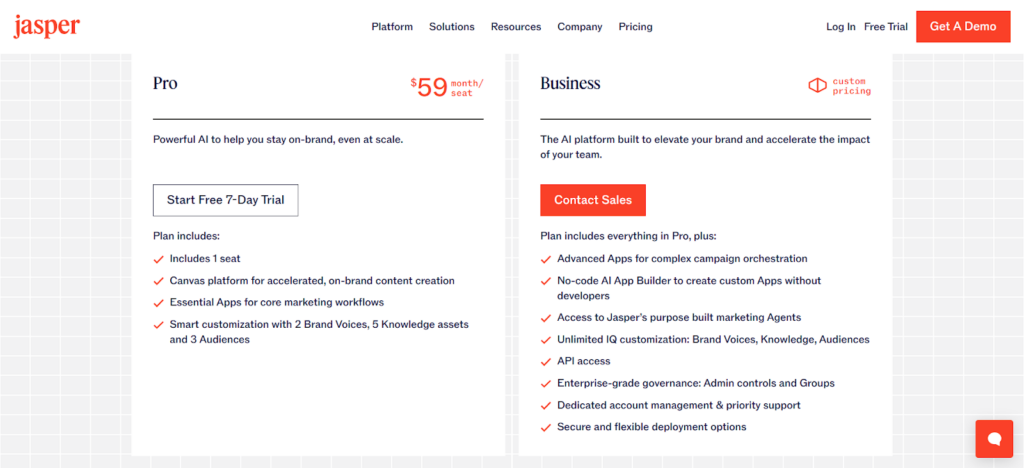
    The Pro plan targets solo marketers and small businesses, while the custom plan requires contacting sales for custom quotes for larger organizations. The pricing positions itself as a premium AI writing tool compared to competitors offering freemium models.

    Jasper Reviews from Trustpilot and G2

    Jasper has a significant number of reviews on Trustpilot. Some of these reviews highlight the availability of numerous templates as well as the speed of its output. Users say, “Jasper’s blog post templates helped me write 20 articles in one week,” and “The brand voice feature captures our company tone perfectly.” 

    Other reviews focus on customer support delays and refund difficulties: “Charged after canceling subscription, support took 3 weeks to respond,” and “Outputs are repetitive, needed heavy editing on every article.”

    On G2, users criticize the editing workload: “Still spend 30-45 minutes editing each AI-generated article” and “Expensive compared to ChatGPT for similar output quality.” 

    Overall sentiment shows satisfaction among high-volume marketing teams but frustration with pricing among solo creators.

    Jasper vs RankPilot

    FeatureJasper AIRankPilot
    Primary FocusAI copywriting templatesAutomated SEO content + Mentions across AI models
    PricingStarts at $59/month (Pro) and custom pricingOnly $59/month for all features (all-in-one SEO)
    Content PublishingManual copy-pasteAuto-publish to WordPress/Webflow/Shopify
    SEO OptimizationSurfer integration (add-on)Built-in keyword research + schema markup
    Multi-LanguageLimited80+ native languages
    Brand VoiceYes (2 voices on Pro)Custom tone matching
    Real-Time ResearchLimitedExpert citations + live data integration

    RankPilot is a top Jasper alternative as it is an all-in-one platform that combines content generation, SEO optimization, and tracking mentions across AI models, which addresses the problem of subscribing to multiple SEO tools.

    However, Jasper maintains advantages in marketing-specific templates (50+ vs. RankPilot’s quality content-first approach) and established team collaboration features.

    For agencies prioritizing organic growth automation over copywriting templates, RankPilot offers stronger SEO-focused value. For marketing teams needing versatile ad copy, social posts, Jasper’s template library provides more immediate utility. The choice depends on whether your priority is comprehensive SEO automation or flexible marketing content creation.

    Final Verdict on Jasper

    Jasper AI is a great AI writing tool for professional marketers and agencies requiring high-volume content. But if you’re a small business, agency, or freelancer who wants an automated SEO workflow, RankPilot provides stronger all-in-one SEO automation. 

    Start by accessing every paid feature on RankPilot for free for 3 days.

    Frase Review

    Promptwatch Review

    Outrank Alternatives

  • Promptwatch Review 2026: Features, Pros & Cons

    Promptwatch Review 2026: Features, Pros & Cons

    This Promptwatch review evaluates the tool’s features and ability to track brand presence across ChatGPT, Gemini, Claude, and Perplexity. 

    While Promptwatch tracks how brands appear across ChatGPT, Claude, Gemini, and Perplexity, then benchmarks that visibility against competitors. Aside from other highlighted limitations by users, the price points may not be suitable for SMBs, freelancers, and agencies seeking a more accessible all-in-one solution.

    Hence, alternatives like Rankpilot have become a go-to option offering stronger rank tracking, audits, content optimisation, and a more budget-conscious pricing point.

    Try RankPilot’s 3-day free trial

    What Is Promptwatch

    Promptwatch is an AI search visibility and Generative Engine Optimisation (GEO) tool that tracks brand mentions, citations, and visibility across AI models like ChatGPT, Claude, Gemini, Perplexity, and Google AI Overviews.

    Promptwatch targets marketing teams, SEO professionals, and agencies who need to understand AI-driven search behaviour beyond traditional Google rankings. Its core value proposition centres on tracking prompts, analysing citations, and identifying content gaps across multiple AI platforms simultaneously.

    Core Features of Promptwatch

    • Prompt tracking: It monitors users’ prompts and flags when AI engines mention the brand in their responses.
    • Citations analysis: The tool shows which sources AI engines cite when discussing a brand, including third-party mentions on Reddit and YouTube. 
    • Agent analytics: Promptwatch tracks how AI agents and assistants interact with a brand’s content, available on Professional and Business tiers.
    • Content agent: It generates AEO (answer engine optimisation) articles, though the number of articles is limited by tiers.
    • Sentiment analysis and content gap analysis: The tool evaluates how AI engines characterise a brand and identifies topics where visibility is weak 
    • Integrations: Promptwatch also connects with Cloudflare, Fastly, Vercel, and other hosting/CDN providers.

    Pros and Cons of Promptwatch

    Pros

    • It tracks AI visibility across ChatGPT, Claude, Gemini, and Perplexity.
    • It has a clean, intuitive interface (though some users reported otherwise)
    • It offers a free trial
    • It has a built-in article generation feature (5/month, 15/month, or 30/month depending on the pricing)
    • It offers country, state, and city-level tracking.

    Cons

    • Users shared that the UI is complex and has a steep learning curve for new users
    • Reported UX bugs with limited escalation paths
    • Starting at $95/month, may be expensive for small businesses
    • Content generation quality rated as weak by users
    • The reporting depth and accuracy consistency require improvement
    • According to users, the Answer Gap report can be difficult for non-SEO professionals to interpret

    Promptwatch Pricing

    Promptwatch offers three primary subscription tiers alongside a 7-day free trial.

    Promptwatch pricing image

    For small businesses that don’t need deep AI-driven visibility analytics or need more consistent content to support their growth, a $95 starter plan may offer less value than an all-in-one SEO/GEO tool like Rankpilot at $59/month.

    Promptwatch User Testimonials

    Positive Reviews

    Users highlight that the tool is very elaborate, giving very useful recommendations on how to improve visibility within AI tools. A user notes the content gap feature 

    “showed us we weren’t showing up in responses because we were missing specific topics” 

    Negative Review

    On the other hand, a 60-day hands-on evaluation by Generate More (across 8 other SaaS clients) shared that: “Promptwatch has more UX errors and bugs than other solutions. There is currently no way to escalate and resolve them. We’re seeing an increasing amount of bugs in the user interface that can’t be dismissed or flagged. This means some core reports we share with customers are faulty.”

    Other user testimonials share that the generated content/articles are weak.

    Promptwatch vs. Alternatives

    FeaturePromptwatchRankPilot
    Core focusAI visibility tracking and GEO analytics across 4 AI enginesDaily content/image generation with optimised AI-citation & tracking AI visibility, built for small businesses to scale organic growth
    Content automationAEO articles limited to plan tier (5/15/30 per month)Daily article generation and publishing
    AI/LLM visibilityPrompt tracking, citations, sentimentContent optimised for citation in ChatGPT and other LLMs
    Pricing$95-$579/month$59/month
    Trial7-day free trial on Essential only3-day free trial to all features
    Built forTeams needing deep AI-visibility analytics across multiple engines and regionsSmall businesses that want one affordable subscription to handle daily content, LLM visibility, and growth without stacking separate tools

    Final Verdict

    Promptwatch offers excellent AI visibility tracking across multiple AI models, with unique features such as crawler log analysis and built-in content generation, though reported UI bugs and weak content warrant caution.

    For teams needing broad AI model coverage and technical crawl insights, Promptwatch justifies its mid-tier pricing. However, small businesses without dedicated SEO resources may find the learning curve and cost too much.

    Hence, a top Promptwatch alternative you can opt for is Rankpilot, which offers a more affordable all-in-one SEO/GEO suite including content automation and AI visibility tracking at $59/month.

  • 8+ Best Outrank.so Alternatives: Which Tool Wins in 2026?

    8+ Best Outrank.so Alternatives: Which Tool Wins in 2026?

    Why Outrank.so is considered one of the most sought-after keyword research, AI-powered content generator is due to its effectiveness in getting the job done.

    But are there better outrank.so seo alternatives that get the job done as well or even better? 

    Yes, there are, and that’s what you are about to explore.

    🏆 Rankpilot is best Outrank alternativeTry it free here

    What’s the Proof that Using AI SEO Optimization Software Really Works?

    Before we go further, let’s clear some doubts about using AI or AI-powered automatic seo software for content marketing and SEO with some proven statistics.

    Research has shown that AI seo tools can improve one’s SEO rankings by 49.2%, and over 86% of SEO professionals have currently adopted the use of AI in their SEO strategy. 

    These statistics further prove that the negative narrative about AI negatively influencing search ranking and SEO is rather a myth.

    The Best Outrank.so SEO Alternatives for Small Businesses, Digital Marketers, Agencies, and Enterprises

    We have selected some of the best outrank. so SEO alternatives available today, including easily tracking mentions across AI models, automated technical SEO audits, content generation, and posting.

    ToolKeyword ResearchContent AutomationUser ExperiencePricing
    RankpilotFully automated daily contentSmart keyword suggestionsAll-in-one platform, User-friendlyAffordable for small businesses
    ClearscopeContent optimization briefsYesUser-friendlyStarts at $129/month
    MarketMuseAI content briefs + strategyYesCollaborativePremium starts at $99/month
    NeuronWriterSemantic SEO content tipsYesUser-friendlyStarts at $ 19/month
    SE RankingMinimal content automationYesFeature-packed, scalableStarts at $52.00/month
    Rank Math Content AIOn-page SEO AI pluginYesSeamless WP integrationStarts at $59/month
    Surfer SEOContent editor with optimizationYesIntuitiveStarts at $79/month
    FraseAI content + question miningYesUser-friendlyStarts at $49/month
    ScalenutAutomated long-form contentYesSimplified, cost-effectiveStarts at $39/month

    1. Rankpilot (An All-in-One Automation Powerhouse)

    One of the best outrank.so SEO alternatives is Rankpilot, which offers an all-in-one model that includes the automation of content generation tailored to individual brand voice, keyword research, and tracking mentions across AI models.

    It is simply an automated SEO platform suitable for small businesses, agencies, and digital marketers who struggle with multiple and costly SEO tools, helping them streamline their entire SEO workflow and rank better on search engines and AI-powered platforms like ChatGPT.

    Rankpilot allows you to easily carry out smart real-time keyword research, generate SEO optimized short or long-form articles, and publish or schedule them automatically with minimal manual effort. Rankpilot is considered one of the best outrank.so, alternative, because aside from having the features of outrank.so, it also addresses some weaknesses of Outrank, like a more affordable subscription, tracking mentions across AI models, and faster automatic publishing.

    🏆 Rankpilot is best Outrank alternativeTry it free here

    What are RankPilot’s Key Features?

    • Smart Keyword Research: RanPilot uses Google Search Console data, People Also Ask questions, topical authority, and intent insights to identify content opportunities that actually drive traffic.
    • Automated Daily Content Generation: RankPilot provides SEO and LLM-optimized articles daily, with real-time keyword research, relevant expert citations, and schema markup, ensuring each content is suited to your brand voice and optimized for both local search engines and AI-powered platforms like ChatGPT.
    • Multi-CMS Publication: Rankpilot allows for instant publication of the generated content to WordPress, Webflow, Shopify, Wix, and other content management systems, which reduces the need for manual uploading and publication of content.
    • It Supports Multiple Languages: Rankpilot supports 20+ languages. This allows businesses to publish content in multiple languages and even expand internationally without hiring multilingual content teams.

    Pricing

    RankPilot pricing is at $59 which reduces the typical spread across 3-5 different tools.

    Pros and Cons

    ProsCons
    Automated daily SEO/LLM-optimized articles with real-time researchOnly 3 days free trial.
    Data-driven content optimization via Google Search Console and People Also Ask analysis to boost content authority and ranking.
    Instant publication to WordPress, Shopify, Wix, and other CMS
    Multi-language support (20+ languages) for global SEO
    Automatic customization of content tone & style to match individual brand voice 
    Tracking mentions across AI models

    Who Should Use RankPilot?

    Those who are most recommended to use RankPilot are those looking for budget-friendly autopilot SEO growth without the need to use multiple tools. They include:

    • Small Businesses
    • Agencies
    • Digital Marketers 

    2. Clearscope (Content Optimization Software)

    Clearscope is one of the best tools for larger enterprise content teams and content marketers due to its focus on precision for content quality, SEO-focused content optimization, and pricing. It’s also an AI-powered content generator built on a Natural Language Processing (NLP) engine, which provides real-time content grade scores and relevant recommendations based on search engine results

    Clearscope pricing image

    Clearscope uses data and competitive analysis to also identify content gaps and help generate content that helps a website build authority by prioritizing search relevance and comprehensive topics.

    What are Clearscope’s Key Features?

    • Content Grading System: Clearscope utilizes a proprietary scoring algorithm that evaluates your content against top competitors, offering actionable recommendations to enhance its relevance and comprehensiveness.
    • Real-Time Optimization: As you write, Clearscope highlights terms and concepts to include, which makes the optimization process easier.
    • SERP Analysis: It also features a deep competitive analysis to show exactly what top-ranking pages cover, helping you create content that matches or exceeds competitive standards.
    • Integration Capabilities: It also allows for integrations with Google Docs, WordPress, and other content management systems to streamline workflows.

    Pricing

    Clearscope starts at $129/month for the Essential plan, with Business plans at $399/month, and a custom price for the Enterprise plan.

    Pros and Cons

    ProsCons
    Focus on content relevance and qualityHigh price point for small teams
    Easy-to-use interface with actionable guidanceFocus only on content optimization

    Who Should Use Clearscope

    Clearscope works best for established businesses with dedicated content teams and publishers managing large content libraries.

    3. MarketMuse (Enterprise-Grade Content Intelligence Software)

    MarketMuse is an SEO AI automation software that focuses on helping businesses build topical authority rather than just focusing on generic keywords, hence we consider it one of the best automated seo software.

    MarketMuse stands out in analyzing your entire content repository, identifying content gaps, and decayed or outdated content, and then recommending data-driven suggestions to help optimize your content for better ranking and authority in your niche. It also scores your keywords and topics and suggests relevant and comprehensive topic clusters.

    marketmuse pricing image

    What are MarketMuse Key Features?

    • Content Inventory Analysis: MarketMuse scans every piece of content on your website to assess its topical depth and performance.
    • SERPs Scoring: It ranks potential keywords and topics based on relevance, competition, and your domain’s existing authority.
    • Personalized Metrics:  MarketMuse provides you with proprietary metrics like Content Score and Content Performance, which help in guiding your content strategy.
    • Content Briefs and Optimization: It generates comprehensive content briefs and provides an editor for optimizing existing or new content.
    • AI-Powered Content Generation: It also offers an AI-content-generating feature for generating and clustering content to ease your entire content strategy.

    Pricing

    MarketMuse starts with a free plan for one user with very limited features and a maximum of 10 queries a month. For premium plans, it starts with $99/month for the Optimize Plan (very limited use cases), $249/month for the Research plan, and $499/month for the Strategy Plan. 

    Pros and Cons

    ProsCons
    It offers deep data analysis for content strategyIt is quite expensive compared to its alternatives
    It is great for building long-term content authorityIt has a complex interface that requires investing more time to learn.
    It is effective for building topical authorityLower subscription tiers have lower query limits, which restrict usage.

    Who Should Use MarketMuse?

    MarketMuse is the best fit SEO automation software for enterprise or large content teams who have substantial budgets, and content publishers in niches with high competition.

    4. NeuronWriter (AI SEO writing optimization Software)

    We consider NeutronWriter as one of the best alternatives for Outrank.so because it focuses on competitive analysis and highlighting gaps, precise SERP, and semantic recommendations to help optimize your articles. When it comes to pricing, NeutronWriter is relatively affordable compared to some SEO automation tools; hence, both small businesses, digital marketers, and agencies can consider it a handy tool.

    What are NeuronWriter Key Features?

    • Advanced Content Analysis: It features analysis of top-ranking pages to suggest semantics/similar words, article structure, and internal linking recommendations.
    • Content Score and E-E-A-T Focus: It provides a clear optimization score and integrates E-E-A-T-related suggestions, such as using expert citations and internal/external links.
    • Competitor Content Structure Analysis: You can use its analysis feature to visualize and compare the outline of top-ranking pages to build and optimize your content structure.
    • AI Content Generation: You can use its AI feature to generate articles, titles, descriptions, and section ideas based on the data obtained from competitor analysis.

    Pricing

    Plans start at $19/month for Bronze (25 content analyses), $37/month for Silver (50 analyses), $57/month for Gold (75 analyses), $77/month for Platinum (100 analyses), and $97/month for Diamond (150 analyses).

    Pros and Cons

    ProsCons
    It’s an affordable option for automated content optimizationIt’s a new platform with a less established track record
    It has good internal linking features
    It focuses on semantic SEO and E-E-A-T optimization

    Who Should Use NeuronWriter?

    NeuronWriter is best for solopreneurs, copywriters, and small agencies with a lean budget.

    5. SE Ranking (All-in-One SEO Management Platform)

    SE Ranking is an SEO optimization tool suitable for small businesses, digital marketers, and agencies due to its cost-effectiveness, its comprehensive all-in-one suite, and its AI feature. Apart from Rankpilot, SE Ranking is considered the next best alternative, especially for small-scale businesses, agencies, and digital marketers who have a lean budget but desire effective results from their SEO, GEO, and content marketing efforts.   

    SE Ranking features competitive research, tracking mentions across AI models,  technical SEO auditing, and rank tracking, making it a unique automated seo software for scaling content marketing and SEO efforts like Rankpilot

    SE Ranking pricing

    What are SE Ranking Key Features?

    • Rank Tracking: SE Ranking tracks your ranking across multiple locations and devices to identify gaps for optimization.
    • Technical SEO Audit: Its audit tool crawls and audits your website to identify technical issues like broken links, crawl errors, and speed issues.
    • Keyword Research & Competitor Analysis: It provides you with detailed insights into your competitors’ organic and paid strategies.
    • AI-powered Content Editor: It has an AI-powered content editor for optimizing content for better ranking.

    Pricing

    SE Ranking offers three plans: Essential at $52.00/month, Pro at $95.20/month, and Business at $207.20/month. All plans include core features with varying limits on projects and keywords.

    Pros and Cons

    ProsCons
    It is great for tracking keyword rankingSome advanced features require higher-tier plans
    It has a comprehensive website audit toolContent optimization is less in-depth compared to other tools
    It’s quite affordable compared to some toolsRank tracking updates slower than dedicated rank trackers

    Who Should Use SE Ranking?

    SE Ranking is best suited for agencies managing multiple clients, digital marketing teams, and businesses.

    6. Rank Math Content AI (WordPress-Native SEO Automation Tool)

    For the vast majority of websites built on WordPress, Rank Math is not foreign as it’s a popular tool for on-page optimization just like Yoast SEO. The “content AI” add-on to this tool makes it even more valuable to WordPress website owners. The Rank Math Content AI operates within the WordPress Gutenberg and Elementor editors, suggesting optimization as you write in the WordPress editor.

    We consider it one of the best AI SEO tools for suggesting and generating different sections of an article based on relevant keywords or intent, while you write. It is also relatively cost-effective, as beyond the AI-powered content generator, you also get access to other premium Rank Math  SEO auditing features to ensure you deliver better optimized content.

    What are Rank Math Content AI Key Features?

    • WordPress Integration: Rank Math is already a native WordPress software. This makes integration with WordPress seamless
    • Content AI: It generates optimized content directly in the WordPress editor based on target keywords and competitive analysis.
    • 40+ SEO Tools: It offers a comprehensive set of on-page analysis tools for including schema markup, content readability, and technical SEO.
    • Schema Generator: It automatically generates appropriate schema markup based on content type.

    Pricing

    Rank Math offers a free version with a good number of features, with Pro plans starting at $5.99/month for the Starter Plan,  $10.99/month for the Creator plan, and $16.99/ month for the Expert plan.

    Pros and Cons

    ProsCons
    Affordable with strong CMS integrationLimited to WordPress users
    Easy to use for WordPress usersIt’s not a full SEO suite
    Helps with on-page SEO automationAI Content quality requires editing

    Who Should Use Rank Math Content AI?

    Rank Math Content AII is best for WordPress-focused agencies managing numerous client sites, bloggers, and small businesses on tight budgets.

    7. Surfer SEO (Data-Driven Content Software)

    Surfer SEO is considered a standard for on-page SEO content optimization, which started as a page analyzer and later evolved into a comprehensive platform for content optimization software. This is based on its content ranking high on SERPs.

    Surfer AI is its recent advancement, which makes it dominantly an automatic seo tool for automating the content generation process completely. It is most suitable for SEO specialists who are always in need of data-driven optimization recommendations.

    Surfer SEO pricing image

    What are Surfer SEO Key Features?

    • Content Editor: Just like Clearscope, but it comes with additional structural recommendations, including paragraph length, heading optimization, and image suggestions.
    • SERP Analyzer: It provides a detailed competitive analysis that reveals exactly why competitors rank, which also includes technical SEO factors like page speed and other Core Web Vitals.
    • Content Planner: Surfer SEO has a Keyword clustering tool that helps build topical authority through strategic content mapping.
    • Surfer AI: The Surfer AI feature automates content generation, which helps in optimizing the content by implementing recommendations directly as it generates the articles.
    • Audit Tool: It also has an audit tool that evaluates existing content and provides specific recommendations for improvement.

    Pricing

    Plans start at $99/month for Essential, scaling to $175/month for the Scale plan and $999/month for the Enterprise.

    Pros and Cons

    ProsCons
    Highly detailed content and competitor analysisIt can be overwhelming for SEO beginners
    Great for modeling content against top search resultsHigh subscription cost compared to some alternatives
    It helps improve topical authority via clustering

    Who Should Use Surfer SEO

    Surfer SEO is best for agencies managing multiple client portfolios, in-house SEO teams at large companies.

    8. Frase (AI-Powered Research and Content Creation Software)

    Frase is an AI-powered SEO tool that helps make content research and creation easier and faster. It plays a significant role in the first few stages of the content lifecycle, like research, competitive analysis, and the generation of valuable outlines. This facilitates research and helps you see what your competitors are doing.

    It uses its AI feature to read and summarize the top SERP results in your niche, making it easier for you to quickly pull in statistics, headings, and competitor questions for your content. You can use this brief to draft sections of the content using its AI writer. Frase is best for content creators and content teams. It is especially helpful for those who want to speed up their research process and need built-in optimization features.

    Frase.io-pricing

    What are Frase Key Features?

    • AI Research Assistant: The research assistant automatically analyzes top search results and generates research briefs with key questions, statistics, and topics to cover.
    • Content Optimization:  It has a real-time scoring system, which is similar to Clearscope and Surfer, that also offers optimization recommendations.
    • Answer Engine: Frase also has a feature that identifies and structures content to target featured snippets and “People Also Ask” queries
    • AI Writer: You can also generate content sections or complete articles based on research briefs and optimization parameters using Frase AI writing feature.
    • Collaboration Tools: It also has a team feature for content brief creation, assignment, and approving workflow for a content team.

    Pricing

    Frase pricing starts at $49/month (1 user, 15 content projects).

    Pros and Cons

    Pros Cons
    Strong emphasis on answering user intent and questionsIt has content project limits on lower tiers that restrict users with a higher project count
    The content brief automation helps save content planning timeLimited technical SEO features
    Affordable entry pointThe AI content quality requires significant editing
    It has a good balance of AI assistance and human control in the content workflow

    Who Should Use Frase

    Frase is a great tool for freelance writers who want to optimize their client content, small businesses that create content occasionally, and agencies that need affordable pricing.

    9. Scalenut (AI-Powered Content Marketing Platform)

    Scalenut is one tool that emphasizes speed and a complete suite of SEO automation. This makes it a great AI-powered SEO tool for filling content calendars speedily and a direct competitor to RankPilot, Outrank.so and Surfer AI in content automation. It focuses on the entire content lifecycle from keyword research to content creation. 

    Scalenut pricing image

    One of Scalenut’s features is the end-to-end “Cruise Mode” feature, which is designed to take a single keyword and, through a guided, four-step process, generate a highly optimized and structurally sound blog post draft within minutes. Scalenut basically helps manage an entire content workflow in one place.

    What are Scalenut Key Features?

    • Cruise Mode: This automates content creation that generates complete, optimized articles from a single keyword input.
    • SEO Hub: It offers a centralized dashboard for planning, creating, and optimizing content with topical clusters.
    • Content Optimizer: It also provides its users with real-time scoring with NLP-based recommendations for improving relevance.
    • SERP Analysis: It offers detailed competitive research showing exactly what top pages in your niche cover.

    Pricing

    Scalenut offers three tiers of pricing: Essential at $39/month (5 articles), Growth at $79/month (30 articles), and Pro at $149/month (unlimited articles). Annual plans provide significant discounts.

    Pros and Cons

    ProsCons
    The “Cruise Mode” speeds content productionSome AI outputs require post-editing
    It has a good balance of content creation and optimizationArticle limits on the lower tiers restrict large content production
    It has a user-friendly interface

    Who Should Use Scalenut?

    Scalenut is suitable for small businesses, digital marketing teams, and content marketers who manage high-volume publishing schedules or want to scale their content production.

    How to Choose the Right Outrank.so Alternative for You

    With the above-provided alternatives, it might be really hard to pick the most suitable SEO automation tool for you since they all come with features you might want. To help you, here are factors to consider:

    Your Business Size and Structure

    If you are a small business with 2 to 10 staff, you should consider SEO tools that provide a comprehensive suite of features and scalability for you and your team at a budget-friendly rate, like RankPilot. This also goes for solopreneurs and agencies in order to minimize cost without sacrificing quality and needed features. Rank Math Content AI and NeuronWriter are good choices, too, among others. For enterprises, MarketMuse or Clearscope is a good choice as it offers the complex and strategic depth that justifies premium investments.

    Consider Your Budget

    You wouldn’t want to spend your entire marketing budget on only SEO automation tools; hence, it’s important to consider how much you are willing to spend on SEO tools. Is it under $50/month, or $50-$150/month, or $150-$400/month, or probably $400+/month? Ensure you are on check, and also consider the best automated seo software that has the features that meet your overall needs

    What’s the Primary Use Case?

    There is SEO automation software that is all-in-one, like RankPilot, and there are some that focus on just some aspects. It’s important to consider what you need the tool for before you hit the purchase button. Some tools are best for content creation, others are suitable for content optimization, while others offer a comprehensive SEO management suite. But as stated earlier, others are an all-in-one software like RankPilot, which is a direct alternative to Outrank.so 

    CMS/Platform and Integration Needs

    There is software that is just native to WordPress, or independent, while others are Multi-CMS/platform compatible. Hence, it’s necessary to consider what works best for you and the CMS you are using. The uniqueness of RankPilot is that it integrates seamlessly with multiple CMS like WordPress, Shopify,  Wix, and other CMS.

    You or Your Team’s Technical Expertise

    It is noteworthy that some SEO software requires an extensive technical know-how, which means the learning curve might be longer for beginners, while others are easier to navigate even for beginners. Consider how well your or your team’s expertise is before choosing a tool.

    Now You Know, So What’s Next?

    One of the most common threads among the best outrank.so seo alternatives is their focus on automation, content quality, integration, and affordability (as much as they can) without limiting effectiveness. 

    As SEO continues evolving toward AI-powered discovery and LLM-optimized content, choosing tools that speedily adapt to these changes positions your business for sustainable organic growth, but you should also note that no tool replaces strategic thinking, audience understanding, and genuine expertise.

    One of the best automated SEO software that offers these capabilities and supports businesses towards strategic growth with functionalities like content creation, optimization, publishing, in one integrated platform is RankPilot.

    SEOBot Review

    AutoSEO Review

  • 9 Best Rankpill Alternatives (Expert Comparison)

    9 Best Rankpill Alternatives (Expert Comparison)

    While Rankpill has been a great SEO tool, a good number of AI SEO tools are now available, offering a diverse range of features to help you rank higher on Google and AI search platforms like ChatGPT

    In this guide, we will explore the best Rankpill alternatives available in 2026, highlighting their key features, pricing, pros, and cons to help you make an informed decision.

    🏆 Rankpilot is best Rankpill alternativeTry it free here

    Why Should You Look for Rankpill Alternatives?

    Because businesses become exhausted from dealing with fragmented workflows, they spend over $500 monthly across multiple platforms for keyword research, content creation, publishing, and tracking mentions across AI models.

    The best Rankpill alternatives streamline these functions, offering all-in-one solutions that save time and reduce costs while delivering the required SEO performance analytics and content automation.

    Another reason is that SEO now goes beyond basic optimization. With AI models like ChatGPT, Perplexity, etc, your content strategy must be address both traditional and AI search in an advanced way beyond just basic optimization.

    These alternatives address some of the limitations of automating time-consuming tasks, provide data-driven insights, and even some of Rankpill’s limitations, like a higher per-month cost compared to these alternatives.

    The Best Rankpill Alternatives

    Tool NameKey FeaturesPricing 
    RankPilotFull SEO automation, humanized AI-generated articles, tracking mentions across AI models, multi-language support (20+ languages), automatic publishing, SEO optimization tools$59/month with free trial
    ClearscopeKeyword research & content optimizationStarts at $129/month
    MarketMuseTopic gap analysis, AI content strategystarts at $99/month
    Jasper AIVersatile AI content creationStarts $69/month
    SEMrush SEO AssistantReal-time SEO content optimization$60/month (does not include other SEMrush features)
    RankdeskSEO analytics, multi-channel publishingRankdesk offers custom pricing for agencies
    Keywordly Auto-PilotKeyword clustering, automated publishingStarts at $14 with limited features
    FraseContent briefs, competitor analysisFrom $15/month

    1. RankPilot (A Complete SEO Automation Platform)

    RankPilot is considered a unique and leading AI SEO tool among the best RankPill alternatives, which positions it as a good AI SEO tool for ranking high on both ChatGPT and Google.

    Rankpilot for SEO/GEO image

    RankPilot directly addresses the issues of high SEO costs, lack of content strategy, time-consuming management, and tracking mentions across AI models by offering an all-in-one/integrated, automated SEO solution.

    Key Features of RankPilot

    • Automated Daily Content Generation: It creates SEO and LLM-optimized articles with real-time research, expert citations, and schema markup
    • Multi-Platform Publishing: You can instantly publish to WordPress, Webflow, Shopify, Wix, and other major CMS platforms with just a click
    • Multi-Language Support: It can natively create content in 20+ languages
    • Data-Driven Optimization: RankPilot leverages Google Search Console data, People Also Ask questions, and topical authority insights to create content
    • Automated Brand Voice Synchronization: It ensures authentic content by adapting to your brand’s tone and style
    • Credible Source Integration: RankPilot also integrates up-to-date statistics, expert quotes, and real-time trends

    Pricing

    RankPilot pricing starts at $59/month.

    Pros

    • It’s automation cuts down the hours spent on SEO tasks.
    • Offers a streamlined platform that reduces the need for multiple tools.
    • It is great for small businesses, agencies, and digital marketers.
    • It increases organic traffic growth
    • It tracks mentions across AI models.

    Cons

    • The free trial is for a few days. (But the pricing is worth the cost).

    2. Clearscope (Enterprise Content Tool)

    Clearscope is a premium content optimization tool known for its precision and emphasis on creating highly relevant and authoritative content. As a Rankpill alternative, it offers in-depth guidance for content writers.

    Clearscope pricing image

    Key Features of Clearscope

    • Content grading system
    • Keyword recommendations
    • Readability analysis
    • Content decay monitoring
    • Google Docs integration
    • Competitive content analysis

    Pricing

    Clearscope Pricing starts at $129/month (Essentials), to custom pricing for the Enterprise plan.

    Pros

    • Unparalleled accuracy in content optimization recommendations.
    • Helps create truly authoritative content.
    • User-friendly interface despite its depth.
    • Strong focus on semantic SEO and topical relevance.

    Cons

    • One of the more expensive Rankpill alternatives.
    • Primarily focused on content optimization, not content generation or link building.
    • It may not be the best fit for small businesses with limited budgets.

    3. MarketMuse (Enterprise Content Tool)

    MarketMuse is an AI-powered content intelligence platform that helps you build comprehensive content strategies and identify content gaps. It’s an advanced Rankpill competitor for an enterprise looking to develop a really good topical authority.

    marketmuse pricing image

    Key Features of MarketMuse

    • Content inventory analysis
    • Topic modeling and clustering
    • Content gap identification
    • Competitive content intelligence
    • Content brief automation
    • SERP X-ray for competitor analysis

    Pricing

    MarketMuse starts with a free plan for one user with very limited features. For premium plans, it starts with $99/month for the Optimize Plan (very limited use cases).

    Pros

    • Excellent for high-level content strategy and topical authority building.
    • Provides deep insights into content performance and opportunities.
    • Automates the process of creating detailed content briefs.

    Cons

    • Very expensive, making it less accessible for small businesses.
    • Has a steep learning curve due to its advanced features.
    • Not focused on direct content generation automation.

    4. Surfer SEO (Content Optimization Tool)

    Surfer SEO is a known content optimization SEO tool that analyzes top-ranking content to provide data-driven recommendations for improving your own. It’s a RankPill competitor just like RankPilot, especially for brands focused on on-page SEO and content relevance.

    Surfer SEO pricing image

    Key Features of Surfer SEO

    • Content Editor with real-time optimization scores
    • SERP Analyzer for competitive research
    • Keyword Research tool
    • Content Planner for strategy development
    • Audit tool for existing content
    • Surfer AI for content generation (add-on)

    Pricing 

    Surfer SEO pricing starts at $99/month (Essential) to $999/month (Enterprise).

    Pros

    • Highly effective for on-page SEO and content optimization.
    • Data-driven approach ensures content aligns with what ranks.
    • Excellent for improving existing content and planning new articles.
    • Strong integration with AI writing tools like Jasper AI.

    Cons

    • Not an all-in-one solution; requires other tools for link building and deeper technical SEO.
    • It can be a bit overwhelming for new users due to the depth of data.
    • Doesn’t automate content generation directly.

    5. SEMrush SEO Writing Assistant (All-in-One SEO Suite Component)

    The SEMrush SEO Writing Assistant is an add-on feature within the broader SEMrush suite, designed to help optimize content for SEO. It serves as a good Rankpill alternative for users already leveraging SEMrush’s extensive toolkit, though it comes with its own pricing, especially if that’s the only feature you need.

    Semrush Writing Assistant pricing image

    Key Features of SEMrush SEO Writing Assistant

    • Real-time SEO recommendations
    • Readability checks
    • Originality verification
    • Tone of voice consistency
    • Integration with Google Docs and WordPress
    • Connected to broader SEMrush tools

    Pricing

    Semrush Writing Assistant is at $60/month.

    Pros

    • Convenient for existing SEMrush users.
    • Provides actionable, real-time feedback while writing.
    • Focuses on key SEO and readability factors.
    • Helps maintain a consistent brand voice.

    Cons

    • Requires a full SEMrush subscription to access other SEMrush features, which can be expensive if you only need the writing assistant.
    • Less comprehensive in content strategy compared to all-in-one tools.
    • The learning curve for beginners is quite long.

    6. Jasper AI (AI Writing Tool)

    Jasper AI is popular for its AI content generation feature, making it a great alternative to Rankpill for businesses prioritizing content creation. It’s great for generating various forms of content efficiently and quickly.

    Jasper ai pricing

    Key Features of Jasper AI

    Advanced AI writing with multiple models

    • 50+ content templates
    • Brand voice customization
    • Jasper Chat for conversational content creation
    • A browser extension for writing anywhere
    • Plagiarism checker integration

    Pricing

    Jasper AI plans start at $59 per month/seat.

    Pros

    • Excellent for generating high-quality, engaging content at scale.
    • Saves significant time in content creation.
    • Versatile for various content marketing needs.
    • Good for overcoming writer’s block.

    Cons

    • Primarily a content generator, it lacks built-in keyword research.
    • Requires integration with other tools (like Surfer SEO) for full SEO optimization.
    • It can be expensive for very high content volumes.

    7. Rankdesk (Project-Based SEO Management)

    Rankdesk is a good SEO management platform that provides a suite of tools for various aspects of search engine optimization. It approaches SEO automation through project-based workflows, offering a strong Rankpill alternative for agencies that need detailed analytics and project management for individual clients.

    Key Features of Rankdesk

    • Client project management dashboard
    • Content brief generation
    • SEO audit capabilities
    • Rank tracking integration
    • Team collaboration tools

    Pricing

    Rankdesk offers custom pricing for agencies in tiers.

    Pros

    • Comprehensive rank tracking and site auditing.
    • Good for agencies managing multiple client projects.
    • Detailed reporting and analytics.

    Cons

    • It can be complex for beginners to navigate.
    • Steeper learning curve

    8. Keywordly Auto-Pilot (Focused on Content Automation)

    Keywordly Auto-Pilot is specifically designed to automate a major part of the content creation and optimization process. This makes it a good Rankpill alternative for businesses that need hands-off content production with minimal configuration.

    Key Features of Keywordly Auto-Pilot

    • Automated content calendar creation
    • Keyword research automation
    • Basic SEO optimization
    • Scheduled content publishing
    • Content performance tracking

    Pricing

    The plans typically range from $14-$79/month, depending on needed features.

    Pros

    • Automates content creation, saving time.
    • Good for businesses needing a steady stream of content.
    • Focuses on keyword targeting for organic visibility.

    Cons

    • It may lack the depth of content customization found in more advanced tools.
    • Less emphasis on LLM optimization compared to RankPilot.

    9. Frase (AI-Powered Research and Content Software)

    Frase is an AI-powered content optimization tool that helps you research, write, and optimize content quickly. It is an intelligent RankPill alternative, just like RankPilot, for content marketers and SEO professionals in need of more efficient SEO/GEO-friendly content.

    Frase.io-pricing

    Key Features of Frase

    • AI content brief generation
    • Question research from People Also Ask
    • Content optimization scoring
    • AI writing capabilities
    • Answer engine optimization
    • SERP analysis dashboard

    Pricing

    Frase pricing starts at $15/month (1 user, 15 content projects).

    Pros

    Efficient for generating detailed content briefs quickly.

    Combines AI writing assistance with SEO optimization.

    Good for identifying and answering user questions.

    User-friendly interface.

    Cons

    • It has content project limits on lower tiers that restrict users with a higher project count.
    • Limited technical SEO features
    • The AI content quality requires significant editing

    How to Choose the Right SEO Automation Tool

    Selecting a suitable SEO automation software among the best Rankpill alternatives depends on your specific needs and budget constraints.

    But you should know that each of these best RankPill alternatives addresses different aspects of SEO automation, but RankPilot, with some other tools, stands out as an all-in-one solution for optimizing for both Google and AI search engines.

    For businesses and agencies that would want an efficient SEO automation tool at a budget-friendly cost, RankPilot offers the complete suite.

    Frequently Asked Questions About Best Rankpill Alternatives

    What is the best alternative to Rankpill for small businesses?

    RankPilot is the best alternative for small businesses because it consolidates all essential SEO functions: keyword research, content creation, publishing, and tracking mentions across AI models, into one affordable platform.

    Which Rankpill competitor offers the best AI content generation?

    While Jasper AI offers advanced AI writing ability, RankPilot provides the best overall value by combining AI content generation with SEO optimization, automated publishing, and tracking mentions across AI models. Jasper requires separate tools for optimization and distribution, increasing total costs and complexity.

    Which tool is best for ranking on ChatGPT and AI search engines?

    RankPilot specifically optimizes content for both traditional search engines and AI platforms like ChatGPT, incorporating LLM-friendly formatting, expert citations, and schema markup that helps AI systems understand and recommend your content. 

    Can these RankPill alternatives publish content automatically?

    RankPilot offers the most comprehensive automated publishing, supporting WordPress, Webflow, Shopify, Wix, and other major platforms natively. SEMrush Writing Assistant and Frase offer limited WordPress integration, while Jasper AI, Surfer SEO, Clearscope, and MarketMuse lack automated publishing capabilities.

    Distribb Review

  • Distribb Review 2026: Features, Pros & Cons

    Distribb Review 2026: Features, Pros & Cons

    This Distribb review analyses the tool’s features as an SEO tool for content automation, backlinks, and more, to help anyone determine whether it’s a good fit for them.

    Distribb is great at reducing manual SEO work for agencies and businesses.

    However, technical glitches and a higher price point are some of the highlighted limitations of Distribb; hence, for SMBs considering a more affordable, SEO/GEO tool with content and image automations, with optimisation for Google and AI models, as well as tracking.

    🏆 Rankpilot is a go to Distribb alternative for $59/month.. Try it free here

    What Is Distribb

    Distribb is an AI-powered SEO automation platform that generates and distributes content across CMS like WordPress and social media. The tool automates keyword research, generation of article, backlinking, and repurposing content for social.

    The tool serves content marketers, digital agencies, and small business owners. What Distribb does is analyse a website’s niche and competitors to find buyer-intent keywords. Another function Distribb performs is turning published posts into social posts for LinkedIn, X, and Instagram.

    Core Features of Distribb

    • Auto Keyword Research: It analyses a website’s niche and competitors to identify buyer-intent keywords.
    • SEO-Optimised Articles: Just like Rankpilot’s daily article publication, the tool offers 30 articles per month on the Pro plan.
    • Automated Backlinks: Also, the tool has a link exchange network feature for backlinks.
    • CMS Integration: The tool integrates with WordPress, Webflow, Shopify, Ghost, Wix, Framer, etc
    • 150+ Languages: It supports native multi-language content generation.
    • Content Calendar & Scheduling: Automatic scheduling with an optional approval gate to review drafts before publishing, just as Rankpilot.

    Pros and Cons

    Pros

    • All-in-one tool (content, backlinks, and social media)
    • Backlink exchange
    • CMS integrations with WordPress and Shopify
    • 3-day free trial
    • 150+ language support for global reach

    Cons

    • Support documentation is limited, with no visible live chat or ticket system
    • According to the user’s review, the Webflow integration requires manual re-formatting on 2 of 8 test articles.
    • Social auto-posting is not yet live
    • Higher price point compared to other tools like Rankpilot
    • The keyword research inside the platform is limited, so several reviewers pair it with a separate keyword tool.

    Distribb Pricing

    Distribb splits its billing into two main plans starting at $97/month, with a 3-day free trial.

    Distribb pricing image

    Distribb User Testimonials

    Via third-party review platforms and posts, Distribb is reviewed as an extremely easy-to-use automation tool. A user shared that:

    “Distribb solves our distribution issues. One piece of search content turns into a whole week of cohesive social posts effortlessly.”

    However, negative or cautionary reviews from users also highlight early operational roadblocks during the onboarding phase. A user stated:

    “Don’t expect this to optimise your technical on-page layout or track indexing parameters. It’s a social amplifier first, and a core search tool second.”

    Another user stated:
    “Social auto-posting is not yet live, and brand voice drift in early articles before calibration settles requires patience and active editing in the first 3-5 weeks.”

    Distribb vs. Alternatives (RankPilot)

    FeatureDistribbRankpilot
    Core focusContent, backlink exchange, and repurposing content for social mediaDaily content & image generation with AI-citation optimisation, built for small businesses to scale organic growth
    Content automation30–90 SEO-optimised articles/month depending on planDaily article generation and publishing 
    Tracking Across AINot offeredTracking across AI models
    Multi-language support150+ languages80+ languages
    Pricing$97-$495/month $59/month
    Trial3-day free trial3-day free trial
    Built forTeams that specifically want backlink acquisition, and with content Small businesses that want one affordable subscription to handle keyword research, daily content, LLM visibility, and multi-language scaling without stacking separate tools.

    Final Verdict

    From this review, Distribb is a reliable all-in-one content and backlink platform offering good results for agencies and businesses.

    However, technical glitches and a higher price point are some notable limitations of the tool.

    For businesses prioritising affordable, transparent content & image automation with optimisation for Google and AI models, Rankpilot is a reliable alternative for small businesses, freelancers, and agencies at $59/month.

  • 7+ Best Soro SEO Alternatives: Which Tool Wins in 2026?

    7+ Best Soro SEO Alternatives: Which Tool Wins in 2026?

    While Soro’s autopilot content sounds perfect, analysing users’ feedback shows the reason why people sometimes search for a SoroSEO alternative. 

    Users have reported generic AI output that misses search intent, shallow audits, and no feature that tracks whether ChatGPT or Perplexity ever mentions your brand. 

    Trustpilot and G2 reviews for Soro are mixed; while users love the time-saving automation, they also criticise the “obviously AI-generated” and “too general” content that is a major E-E-A-T risk for specialised niches. 

    Here are 7+ smarter alternatives, ranked by features and value.

    🏆 Winner for ranking on Google & ChatGPT is Rankpilot. Try it free here 🏆

    Comparison Table of Soro SEO Vs. Alternatives

    ToolStarting PriceAI/LLM TrackingBest For
    RankPilot$59/monthYesWinner for Small businesses
    Soro$39/monthNoLow quality content generation
    SEObot$49/monthNoBudget solo bloggers
    Arvow$69/monthNoCredit-based publishing
    Sorank$99/monthYesSEO + GEO per site
    Rankability$124/monthNoAgency reporting
    Frase$49/monthYesResearch + briefs
    Distribb$97/monthNoContent + social distribution

    7+ Best Soro SEO Alternatives

    #1 RankPilot

    RankPilot is considered one of the top Soro SEO alternatives, as an all-in-one SEO/GEO tool that fills Soro’s content and visibility gaps, such as daily article generation, brand voice consistency, plus dedicated optimisation and tracking to get cited in ChatGPT and other LLMs, all in one subscription.

    As an all-in-one SEO/GEO tool, RankPilot also allows you to publish directly to your  WordPress, Webflow, Shopify, and Wix sites, and the content is built around real-time research, expert citations, and schema markup rather than a generic AI draft.

    Rankpilot for SEO/GEO image

    Rankpilot also supports content in 80+ languages, generates relevant images alongside your content, performs relevant internal linking, drawing on Google Search Console data and People Also Ask questions to sharpen topical relevance.

    Rankpilot is for Small business owners, marketers, and agencies who’ve outgrown a pure autopilot writer and want daily content and LLM visibility handled in the same place, without juggling separate tools.

    Rankpilot’s User Testimonial

    A first-time user comparing Rankpilot’s content with Soro stated:

    “The local visuals and content surprised us positively. It’s not just generic text; it actually reflects our brand and location.”

    “As a consultant leading teams, I know time and results matter. Up to 30 quality articles a month, clear results, fast support, and new customers from ChatGPT. That’s what every small business needs.”

    Try RankPilot’s 3-day free trial

    Key Features of RankPilot

    • Automated Daily Content Generation: It creates SEO and LLM-optimised articles with real-time research, expert citations, and schema markup
    • Multi-Platform Publishing: You can instantly publish to WordPress, Webflow, Shopify, Wix, and other major CMS platforms with just a click
    • Multi-Language Support: It can natively create content in 80+ languages
    • Data-Driven Optimisation: RankPilot leverages Google Search Console data, People Also Ask questions, and topical authority insights to create content
    • Automated Brand Voice Synchronisation: It ensures authentic content by adapting to your brand’s tone and style
    • Credible Source Integration: RankPilot also integrates up-to-date statistics, expert quotes, and real-time trends
    • AI Visibility Tracking: With Rankpilot, you can track your mentions across AI models like ChatGPT, Claude, Perplexity, etc.

    Pricing

    RankPilot pricing is at $59/month.

    Pros

    • It’s automation cuts down the hours spent on SEO tasks.
    • Offers a streamlined platform that reduces the need for multiple tools.
    • It is great for small businesses, agencies, and digital marketers.
    • It increases organic traffic growth without outsourcing expensive backlinks.

    Cons

    • The free trial is for a few days. (But the pricing is worth the cost).

    #2 Sorank

    Sorank is an SEO/GEO that positions itself as a tool that helps websites get cited on ChatGPT, Perplexity, Claude, and Gemini answers.

    The tool also includes an AI agent that automatically fixes technical SEO errors, a GEO Leaderboard comparing your AI-answer visibility against competitors, and social media content for LinkedIn, Reddit, and X. Another feature of the tool is the automated backlink generation.

    Unlike Rankpilot and some other tools that automate your daily content, Sorank only provides you with 20 articles per each subscription.

    Sorank Users’ Testimonials

    “The pitch to rank on Google and AI on autopilot is executed beautifully here. The free MCP server implementation is clean, making it a great option for agencies managing multiple client setups.”

    “The platform lacks a public REST API to export data in bulk. Additionally, because it forces a flat $99 per site pricing strategy, running a large portfolio scales your costs linearly without volume discounts.”

    Key Features

    • SEO Scoring: Page-level analysis with letter grades (A-F)
    • GEO Scoring: AI optimisation assessment across 5 pillars: content citability, 
    • It monitors brand citations across AI engines
    • Content Readability Analysis: Sentence distribution, readability score, keyword density
    • Technical SEO Audit: Indexability, crawlability, robots.txt analysis
    • Automated backlink exchange
    • It supports 25+ languages

    Pricing

    Sorank’s pricing runs at $99/month per website, since the full audit, article, backlink, and AI-tracking system operates per domain.

    Pros

    • It tracks brand mentions across AI engines
    • It offers comprehensive GEO/SEO audits
    • It gives clear, actionable recommendations

    Cons

    • Per-website pricing gets expensive fast for agencies managing multiple domains. 
    • It’s focus on GEO may overlook traditional SEO components

    #3 SEObot

    SEObot is another tool that automates keyword research, article writing, and publishing across CMS, similar to Soro SEO. Unlike some standard content writing AI that waits for your command, Seobotai acts as an “SEO Robot” that works in the background, just as Rankpilot.

    The tool integrates with WordPress and Shopify and produces content in multiple languages. SEObot is great for teams and businesses that need to publish high-volume, SEO-optimised content.

    seobot pricing image

    SEObot Users’ Testimonials

    “I’ve tried a few SEO content creators, and where most sound too much like automated writing, SEObot stands out in its more human-sounding output.”

    “The tool works for basic indexing volume, but it could use a much better user interface and a more intuitive dashboard. Navigation feels clunky when you are juggling multiple domains.”

    Key Features

    • Automated keyword research with competition analysis
    • Automated content refresh for outdated articles
    • Topic cluster planning for authority building
    • Google SERP analysis with featured snippet targeting
    • Internal linking automation based on semantic relevance

    Pricing Plans

    Seobot pricing is at $49/month

    Pros

    • Comprehensive feature set reduces the need for separate SEO tools
    • Content refresh automation extends the ROI of existing articles
    • Topic cluster planning improves topical authority systematically

    Cons

    • No AI-search visibility tracking
    • Steeper learning curve than simpler AI writing assistants
    • Some features duplicate functionality that businesses may already have

    #4 BabyLoveGrowth

    Babylovegrowth is an all-in-one AI SEO/GEO automation tool that helps business owners and marketers enhance their SEO/GEO efforts. It offers content generation and AI-search visibility tracking, which is closer in scope to RankPilot than to Soro. 

    Despite its strengths in identifying SEO gaps and building authority through a backlink network, users’ testimonials about Babylovegrowth show that it still has lapses, especially since the generated content usually needs heavy manual editing. They also highlighted that you will also need to fact-check because sometimes, some factual information is wrong, alongside limited technical integration. 

    Babylovegrowth pricing image

    BabyLoveGrowth Users’ Testimonials

    “The automated content calendar and the ease of use are stellar for our small marketing squad. It lets us dynamically update and scale out content pipelines without needing full-time copywriters.”

     “When it comes to actual content quality, it falls flat. The writing often feels shallow, robotic, or full of factual errors that require heavy editing loops before going anywhere near our real domain.”

    Key Features

    • Automated content plan
    • Automated backlink exchange
    • 50+ native languages
    • Automated keyword research
    • Competitive gap audit
    • WordPress, Webflow, Shopify, Wix Integration

    Pricing

    BabyLoveGrowth pricing is at $99/month

    Pros

    • 100% automated content + backlinks via network
    • Native multilingual support 
    • Tracks visibility on Google and in AI engines

    Cons

    • Quality control on the backlink network requires oversight
    • Some users report payment/billing issues 
    • Users complained about generic content
    • Occasional setup errors requiring support intervention 
    • Slow support

    #5 Arvow

    Arvow (formerly Journalist AI) is a content-automation tool that is built around a credit system. This means it generates articles, publishes across multiple CMS platforms, and lets AI agents flag and fix on-page SEO issues automatically. 

    While Arvow positions itself as a tool that helps websites improve their ranking on Google, get cited by ChatGPT, and support agency content workflows, one of the conflicting issues with the tool is that users have been sharing negative reviews about using the tool, such as calling it “a glorified ChatGPT wrapper,” among others.

    Arvow Users’ Testimonials

    “The automation saves hours every week, articles go live on our site without us touching anything.” 

    “Factual accuracy on highly specialized or technical topics requires intensive manual checking. If you expect articles to go live with zero human edits, you will be disappointed. Also, watch your billing cycles carefully, as cancellations can sometimes be sticky.”

    Key Features

    • It generates SEO articles from keyword research to headlines
    • It schedules content from keywords, RSS feeds, YouTube, and news events
    • AI SEO Agent assistant that audits and auto-fixes technical SEO (schema, meta titles, headings, internal links, alt texts, redirects)
    • It converts YouTube videos into structured blog posts
    • It auto-generates and publishes social posts from blog content
    • It supports 150+ languages

    Pricing

    Arvow pricing currently starts around $69/month for the Solo plan, covering 1,000 monthly credits and basic publishing integrations, with Business and Agency tiers scaling up from there.

    Pros

    • It generates full articles with images and internal links
    • It auto-fixes technical SEO issues
    • It support multiple languages

    Cons

    • It has a very poor customer support record 
    • There are refund policy issues reported by multiple users 
    • The content often misses audience targeting 

    #6 Rankability

    Rankability is an AI-powered SEO optimisation assistant that helps with technical auditing and content recommendations, helping businesses identify and fix issues preventing them from ranking higher in search results.

    Rankability simplifies the technical aspects of SEO to ensure users focus on changes that matter most to their websites.

    While it’s helpful for guidance, it requires manual content creation and implementation, which is a gap Soro SEO alternatives like RankPilot remove entirely by automating content creation, ensuring every recommendation translates into published, optimised articles.

    Users’ Testimonials

    “For pinpointing structural leaks and script bloat on complex directories, Rankability is unmatched. It saves our technical team hours of crawling.”

    Key Features

    • AI-driven content optimisation recommendations
    • Technical SEO audits covering critical ranking factors
    • Keyword opportunity identification
    • Competitor content gap analysis
    • On-page SEO scoring and suggestions
    • Rank tracking for target keywords
    • User-friendly reports accessible to non-experts

    Pricing

    Rankability’s pricing starts at $124/month.

    Pros

    • In-depth technical audits
    • Tracks both Google and AI platform visibility

    Cons

    • Limited content generation features
    • Requires pairing with a content tool
    • The AI draft still needs an editorial pass before it’s client-ready

    #7 Frase

    Frase is another AI-powered SEO tool that helps make content research and creation easier and faster by carrying out keyword research, competitive analysis, and generating content outlines

    The tool uses its AI feature to read and summarise the top SERP results in your niche, making it easier for you to quickly pull in statistics, headings, and competitor questions for your content.

    Frase.io-pricing

    You can use this brief to draft sections of the content using its AI writer. Frase is best for content creators and content teams. It is especially helpful for those who want to speed up their research process and need built-in optimisation features.

    Frase Users’ Testimonials

    “Before Frase, we could maybe do one post a week. Now we can confidently do three to four a week for each client, and know it’s competitive.”

    “The user interface of Frase.io left much to be desired. It felt less intuitive, buggy, and glitchy… In one instance, the entire text lacked the letter ‘r’, resulting in numerous misspellings.”

    Key Features

    • AI content brief generation
    • Question research from People Also Ask
    • Content optimization scoring
    • AI writing capabilities
    • Answer engine optimization
    • SERP analysis dashboard

    Pricing

    Frase offers three tiers: Starter at $49/month (1 user, 10 content projects), Professional at $129/month, Scale at $299/month, and Enterprise with custom pricing.

    Pros

    • Strong emphasis on answering user intent and questions
    • The content brief automation helps save content planning time
    • Affordable entry point
    • It has a good balance of AI assistance and human control in the content workflow

    Cons

    • It has content project limits on lower tiers that restrict users with a higher project count
    • Limited technical SEO features
    • The AI content quality requires significant editing

    #8 Distribb

    Distribb positions itself as a full-stack SEO content workflow engine that runs on autopilot. This includes keyword research, long-form writing, publishing, backlink acquisition, and repurposing content for social media. 

    The tool analyses a website’s niche and competitors to find buyer-intent keywords, then creates a content calendar automatically so articles get written, scheduled, and published. Another function Distribb can perform is turning published posts into social posts for LinkedIn, X, and Instagram. 

    Distribb Users’ Testimonials

    “Distribb solves our distribution issues. One piece of search content turns into a whole week of cohesive social posts effortlessly.”

    “Don’t expect this to optimise your technical on-page layout or track indexing parameters. It’s a social amplifier first, and a core search tool second.”

    Key Features

    • Automate backlink exchange
    • Original data research
    • Keyword research
    • Content publication direct to WordPress, Webflow, Shopify
    • Automated SEO workflow 

    Pricing

    Distribb’s pricing starts at $97/month for Pro and $495/month for the Accelerator plan

    Pros

    • Claimed complete SEO suite: keywords, calendar, articles, CMS, internal links, backlinks, tracking
    • Backlink Exchange integrated
    • Repurposing content for social media

    Cons

    • Automation level requires oversight before trusting strategic domains
    • No technical SEO audit: keyword research inside the platform is limited, so several reviewers pair it with a separate keyword tool.

    Conclusion

    While Soro provides affordable autopilot content, some users have shared concerns that the AI-generated output occasionally requires manual editing, particularly in competitive or highly technical niches and that the content can feel generic in niche-focused content where a differentiated brand voice matters more.

    These are concerns that influence a brand’s authenticity and visibility in search engines and AI answers.

    For 2026, Rankpilot is considered a top Soro alternative that ensures humanised and optimised SEO/GEO daily content, consistent brand-voice, and tracking across LLMs all in one platform. 

  • How to Rank Your Product on ChatGPT

    How to Rank Your Product on ChatGPT

    According to Sam Altman, the CEO of OpenAI, ChatGPT has weekly active users of more than 800 million as of September 2026. What this means for e-commerce businesses is that there is a high potential of getting more visibility, building trust, getting traffic, and making sales when people search for what they sell in ChatGPT. If you are an e-commerce business owner, this makes the need for you to learn how to rank your products on ChatGPT and other AI models.

    This basically means showing up when someone types “best vacuum cleaner for offices” or “recommended vacuum cleaner for marble tiles” into ChatGPT. 

    The benefit of being the one ChatGPT recommends goes beyond visibility or traffic; it basically builds trust with those ChatGPT users because it signals that the vacuum cleaner you sell is of high quality. 

    By the end, you’ll know exactly how to optimize your product so ChatGPT recommends it to potential customers in the first answer it gives them.

    What Does ChatGPT Product Ranking Mean & Its Importance to Your Product?

    ChatGPT product ranking refers to how generative AI like ChatGPT recommends, mentions, or suggests your product when users ask questions relevant to the products you sell.

    Unlike traditional search engines like Google that show a list of links with brief descriptions and images, ChatGPT provides direct product recommendations in conversational responses.

    It’s just like when someone searches Google for “the best ergonomic standing desk for a small office?” or “Where can I buy a durable, waterproof pet bed?” They get several blue links to click through. When they ask ChatGPT the same question, they get a curated response that might mention 3-6 specific standing desks or waterproof pet bed stores with explanations of why each one is a great choice.

    Why ChatGPT Product Visibility is Important to Your Product

    High Buying Intent

    In most cases, when people ask ChatGPT for product recommendations, they are usually ready to buy. They’re seeking specific solutions to their problems and not just browsing. So ranking means high buying potential for your product.

    Growing Market Share

    While Google still dominates search, ChatGPT and similar AI models are rapidly getting more users. If you optimize your product descriptions for AI now, even at this early phase, you will have a significant advantage and better market share as this trend advances.

    Direct Recommendations With Less Competition

    Unlike Google, where you compete for attention with ads, featured snippets, and ten other organic results, ChatGPT typically recommends a few products. If you’re one of them, you have the user’s full attention. Hence, the competition is less.

    Cost-Effective Visibility

    Unlike paid ads that require constant financial investment, optimizing for AI ranking requires significantly less investment effort and delivers the needed results.

    Builds Trust

    AI recommendations carry significant weight with users. When ChatGPT suggests your vacuum cleaner, it comes with a “suggested” credibility that regular ads can’t give.

    How ChatGPT Ranks Products Differently From Google

    If you’ve tried SEO on Google, Bing, or other search engines, you know it’s focused on things like:

    • On-page keyword optimization
    • Backlink quantity and quality
    • Mobile responsiveness
    • User engagement metrics
    • Page loading speed

    Google basically shows you a list of websites, and you decide which to visit based on titles, descriptions, and rankings.

    ChatGPT’s ranking system operates differently by combining advanced training data with real-time data retrieval (from sources like Bing or its own search crawler). It basically includes:

    • Training data that includes web content, reviews, and discussions
    • Real-time web searches (in some versions)
    • Patterns about what products are frequently mentioned together
    • Credible, factual information about products
    • Structured data that AI can easily interpret

    ChatGPT prioritizes relevance, credibility, and clarity over the regular SEO factors. It looks for:

    • Factual accuracy: Is the information about your product consistent across multiple sources?
    • Authority signals: Is your product mentioned on reputable websites, forums, and review platforms?
    • Structured information: Can AI easily extract key details like pricing, features, and specifications?
    • Genuine social proof: Are there verified reviews of real user experiences?
    • Recency: Is the product information current and up-to-date?

    This means you need to think less about keyword density and more about creating clear, factual, authoritative product information that ChatGPT or other AI models can clearly recommend.

    Ranking FactorTraditional Google SEOAI (ChatGPT) Ranking
    GoalRanking Pages: To deliver a list of relevant links.Generating Answers: To deliver a single, comprehensive, and helpful text response.
    Authority FocusBacklinks & Domain Age (the number of reputable sites that link to you)Credibility & Citation Frequency: How often you are mentioned accurately in high-quality, structured, and fact-rich content across the web (backlink in another way).
    Content PriorityKeywords & Topical Depth: Content that covers a topic thoroughly.Clarity & Extractable: Content that is easily summarized, factual, uses lists/tables, and directly answers user questions (specifications, size, warranty).
    Data FormatHTML Text: Reads the entire page content.Structured Data (Schema): Prioritizes machine-readable data for fast, accurate fact-extraction.

    How to Rank Your Product on ChatGPT (8 Strategies)

    1. Create Factual, Data-Driven Product Descriptions

    Ranking your product on ChatGPT starts with the content of your product descriptions. Your product pages should not be generic marketing copy but a rich database of helpful decision-making information about the product.

    Focus on Specifications and Important Product Details

    AI models prefer specific, measurable product information where accurate specifications are provided.

    Examples

    Weak description: “Our wireless earbuds deliver exceptional audio quality and long battery life, perfect for music lovers on the go.”

    Strong description: “These wireless earbuds feature 40mm neodymium drivers with a frequency response of 20Hz-20kHz, Active Noise Cancellation up to 30dB, and 8 hours of playback time on a single charge (32 hours with charging case). They support Bluetooth 5.2 with a range of 10 meters and include IPX4 water resistance.”

    The second description gives AI systems relevant data points to reference when recommending products. When someone asks ChatGPT about wireless earbuds with good battery life, the AI can confidently cite the 8-hour specification and recommend your earbuds.

    Highlight Real Benefits with Supporting Evidence

    Beyond the specifications, explain the benefits of the product, like how it solves a problem or addresses a pain point.

    Example

    “The ergonomic design reduces ear fatigue during extended use. Independent testing showed users could wear these earbuds comfortably for 6+ hours without discomfort, compared to an industry average of 3-4 hours.”

    Highlighting the benefits and supporting evidence provides AI systems with factual evidence they can reference.

    Use Clear, Simple Language

    Try as much as you can to avoid marketing jargon and buzzwords that don’t convey the ideal message because AI systems only want to extract the clear meaning from your content.

    Write as if you’re explaining the product to someone who’s genuinely trying to understand what it does and whether it meets their needs.

    Include Comparison Context

    Including comparison content might not always be relevant, but it also helps AI systems understand where your product fits in the market.

    You can include phrases like “compared to traditional models,” “unlike standard options,” or “similar performance to products costing 30% more.” This contextual information helps AI provide more contextual recommendations.

    Use Structured Content Formats

    You should also organize product descriptions with clear sections as follows:

    • Overview: What the product is and who it’s for
    • Key specifications: Technical details in an easy-to-scan format
    • Primary benefits: Main problems it solves or needs it meets
    • Use cases: Specific situations where the product excels
    • Compatibility: What it works with (devices, systems, accessories)
    • What’s included: Package contents

    This structured approach makes it easy for AI systems to extract specific details when answering user questions.

    RankPilot is well known for creating this type of product content. It basically generates SEO and LLM-optimized articles backed by real-time research and expert citations.

    For e-commerce website owners, instead of spending hours creating data-driven descriptions manually, RankPilot automates the process while ensuring your content meets both Google’s quality standards and AI systems’ need for factual accuracy. This dual optimization is the modern e-commerce optimization needed for businesses to succeed across all platforms.

    2. Implement Structured Data and Schema Markup

    When you effectively implement structured data, give AI a cheat sheet about your product. It’s code added to your website that organizes information in a way machines can easily read.

    What Is Schema Markup?

    Schema markup is a specific vocabulary of tags (or microdata) you add to your HTML to improve the way search engines and AI read and represent your page in search results.

    Types of Schema for E-commerce
    Schema TypeWhat It DoesIts Importance to ChatGPT
    Product SchemaIdentifies the page as a product. It includes the name, description, image, and Brand.Essential for AI to confirm it’s a real item and not just an article mentioning an item.
    Offer SchemaNested within Product, it specifies the price, currency, SKU, and availability/stock level.Allows AI to give an accurate, real-time answer to “How much does the desk cost, and is it in stock?”
    Review / AggregateRatingDisplays the average star rating and number of verified customer reviews.Directly feeds the AI the credibility signals it uses for ranking/recommendation.
    FAQPage SchemaMarks up a visible list of questions and answers.A gift to the AI! It’s an instant answer to “What are the washing instructions?” or “What colors does it come in?”

    RankPilot automatically integrates schema markup into the content it generates, ensuring your product information is structured correctly for AI systems.

    This saves hours of technical work and eliminates the risk of implementation errors that could harm your product’s visibility. RankPilot’s content includes the necessary structured data signals that both Google and ChatGPT use to understand and rank your products.

    3. Gather and Manage Verified Customer Reviews

    In the simplest terms, reviews are social proof that AI trusts. But not all reviews carry equal weight in the eyes of AI-driven platforms because a generic review like “Love this phone case, 5 stars!” isn’t enough.

    When ChatGPT considers recommending a product, these reviews serve as third-party validation because they provide:

    • Evidence that real people used your product
    • Specific details about user experiences
    • Common use cases and applications
    • Honest assessments of strengths and weaknesses

    Also, AI wants attribute-rich feedback reviews that use specific keywords and phrases that are relevant to user search queries. Here are the best practices for gathering and managing customer reviews.

    • Request Specific Feedback: When asking for a review, prompt your customers to mention specific attributes or uses that they benefited from:
    • You can ask: “Did the ‘non-slip material’ perform well on your tile floor? Comment on its durability after washing.”
    • Display Reviews Strategically: On your product page, organize reviews by attributes if possible (e.g., “Reviews on Durability,” “Feedback on Size Accuracy,” “Reviews on Customer Service”).
    • Ensure all your reviews have the correct Review schema markup. This allows AI to easily read the review text, the star rating, and the author directly, improving your credibility. 

    4. Keep Product Information Updated Frequently

    AI systems, especially those that access real-time web data like ChatGPT, value fresh and up-to-date product descriptions/content because outdated data reduces your chances of being cited or recommended.

    Regularly updating your product details signals that your information is reliable and your product is actively available. Some of the information to regularly update includes:

    • Price and Availability: Update your pricing and current stock availability immediately. If a size or color is out of stock, this needs to be current on your page and in your Schema.
    • Shipping and Returns: If your free shipping threshold or return policy changes, update your content and any relevant data points.
    • New Versions: If you release an updated model (e.g., “Vacuum cleaner V3”), make sure that versioning and its comparison to V2 are clear and factual on the product page.


    Also, create time-sensitive content around your products:

    • Seasonal relevance: “Best Winter Running Shoes 2026” or “Top Outdoor Speakers for Summer.”
    • Current comparisons: Update comparison articles when competitors release new models
    • Recent news: Reference recent industry developments or trends your product addresses
    • Updated guides: Refresh buying guides and how-to content annually

    This is another area where RankPilot provides significant value. It offers an automated daily content that’s always current and optimized for both search engines and AI platforms.

    Instead of manually updating product information and creating fresh content, RankPilot handles this systematically, ensuring your products are visible as AI systems prioritize recent information. Its real-time research capabilities mean your content always reflects the latest trends and data.

    5. Customer Q&A That Matches Conversational Queries

    Because people ask AI questions conversationally, not in keyword-stuffed phrases, your product pages should reflect this natural language tone.

    The best way to approach this is to target the “Why, How, and Which” queries in your existing customer support tickets and live chat logs. Use these questions to create your FAQ section. For example, if a user queries,  “Is this leather jacket water-resistant?”

    • Your FAQ Heading: “Is the ‘Classic Roadster’ Leather Jacket waterproof or water-resistant?”
    • Your Direct Answer: “The jacket is treated with a DWR (Durable Water Repellent) finish, making it highly water-resistant and suitable for light rain, but it is not fully waterproof.”

    6. Build Authority Through Backlinks and Industry Mentions

    While ChatGPT doesn’t rank based on backlinks the way Google does, authoritative mentions across the web significantly influence whether AI systems recommend your products. Product credibility is determined by AI models based on:

    • Diverse Sources: Products mentioned across multiple independent sources appear more legitimate than those discussed only on their own website.
    • Authority of Sources: Mentions from industry publications, expert blogs, and established retailers carry more weight than just random websites.
    • Contextual Relevance: Links and mentions from topically relevant sources matter more than generic directory listings.
    • Recency of Mentions: Recent coverage signals that your product is current and actively relevant in your industry.

    Basically, if reputable sources in your industry frequently reference your product, AI systems interpret this as validation that your product is noteworthy and credible.

    Where to Build Authoritative Mentions

    • Industry publications and blogs: Pitch your product for reviews or inclusion in roundup articles. One mention in a respected industry publication can be worth dozens of generic backlinks.
    • Expert reviewer sites: Sites like Wirecutter, CNET, or industry-specific review platforms provide high-authority validation.
    • Niche communities and forums: Authentic discussions about your product on Reddit, specialized forums, or community sites signal genuine user interest.
    • Complementary product pages: Products often sold together should link to each other. If you sell camera lenses, links from camera body manufacturers add contextual authority.
    • Industry directories: Legitimate, curated directories (not spam link farms) provide baseline authority.
    • News coverage: Press releases and news articles about product launches, awards, or innovations build credibility.

    Build Backlinks Without Spending Thousands

    The truth is, acquiring backlinks is expensive and time-consuming. Individual high-quality links can cost $150-$300, and cold outreach campaigns often yield less than 1% response rates.

    One of RankPilot’s features is the built-in backlink exchange functionality that automatically generates high-quality, niche-relevant backlinks without additional cost. Instead of manual outreach or paying hundreds per link, RankPilot’s automated system connects you with relevant authoritative websites for natural link building.

    7. Structure Your Content to Be AI-Friendly

    AI models process language not that much differently from humans, and they also prefer clarity, structure, and conciseness above all else. Your goal is to make your content easy to extract and summarize.

    Here are the best practices for this:

    1. Ensure Clear Headings, Lists, and Tables

    • Use Clear Headings (H1, H2, H3): Headings act as a table of contents for the AI. Every section should have a descriptive header.
    • Prioritize Lists (Bulleted & Numbered): Listicles, bullet points, and numbered steps are the easiest format for an AI to parse, summarize, and re-output in its own response. Use them liberally for features, assembly instructions, and shipping requirements.
    • Use Tables for Comparisons and Specifications: Tables are the most powerful format for data that an AI will use for comparisons or factual summaries (e.g., size charts, material grades).

    2. Prioritize Concise, Factual Language

    • Keep Paragraphs Short: Keep the paragraphs short because long, dense blocks of text are difficult for an AI to process quickly.
    • Avoid Jargon and Hyperbole: AI prefers informational, straightforward writing over heavy marketing language. Be factual, not flowery.
    • Front-Load Key Information: Use the “inverted pyramid” style of writing: put the most important takeaway, fact, or answer in the very first sentence of a paragraph or section.
    • Include a TL;DR Summary: For long guides or comprehensive product pages, adding a “Summary” or “Key Takeaways” section at the top (formatted with bullet points) gives the AI an instant, perfectly structured summary to pull from.

    8. Avoid Common Mistakes That Hurt AI Ranking

    The truth is, even the smallest error can cause the AI to pass over your product instead of parsing it. Here are some of the mistakes to avoid:

    Mistake Mistake DescriptionExplanation / ExampleRecommended Action
    1Using Only Marketing JargonOverly promotional language confuses AI.Use clear, factual descriptions: “Comprehensive 6-week program with 30+ video lessons”
    2Inconsistent Information Across PlatformsConflicting prices/info across website, social, and reviews hurt AI trust.Maintain consistent info on website, social media, marketplaces, directories, and reviews
    3Neglecting Technical SEOBroken links, slow loading, and missing meta descriptions affect AI indirectly through search engines.Fix links, improve speed, add meta descriptions, ensure mobile-friendliness, and good site structure
    4Ignoring Negative ReviewsDeleting or ignoring negative feedback reduces credibility.Respond professionally, address concerns, and show care in handling criticism
    5Keyword StuffingOverusing keywords lowers comprehension and AI ranking.Use natural language focused on user needs
    6Providing Incomplete InformationMissing key details like pricing, duration, and prerequisites causes AI to skip your product.Clearly state what it is, who it’s for, cost, duration, learning outcomes, requirements, and differentiators
    7Relying Solely on Your Own WebsiteLack of third-party mentions limits authority and ranking signals.Build presence on review platforms, directories, forums, social media, and guest posts
    8Setting and ForgettingAI ranking needs regular updates; markets and AI models change.Review and refresh optimization quarterly
    9Copying CompetitorsDuplicate or very similar content lowers AI ranking for both parties.Create authentic, unique product descriptions highlighting your value proposition
    10Ignoring DataNot tracking outcomes means optimizing without insight.Use analytics, test different approaches, and refine based on results.

    Start Optimizing Your Product for ChatGPT

    Now you know that ranking products on ChatGPT doesn’t require manipulative tactics or expensive tools/agencies.

    It requires creating factual, comprehensive product details/information, structuring data properly, building genuine authority, and maintaining accuracy across platforms.

    It’s best to start with the fundamentals. Audit your current product pages and identify gaps in specifications, missing schema markup, or inconsistent information, then implement structured data if you haven’t already, and begin collecting detailed customer reviews.

    Instead of manually creating content, implementing schema, and conducting outreach for backlinks, RankPilot automates the entire process with daily AI and SEO-optimized content, built-in backlink exchange, and comprehensive implementation of structured data.

    Frequently Asked Questions

    How to rank a website using ChatGPT?

    Ranking a website on ChatGPT differs from traditional SEO. Focus on creating clear, factual product information with schema markup, earning authoritative backlinks, gathering verified reviews, and maintaining consistent information across platforms. ChatGPT prioritizes credibility and clarity over traditional ranking factors.

    How do you rank your brand on ChatGPT?

    To rank your brand on ChatGPT, establish strong authority signals through mentions in reputable publications, comprehensive product information on your website, active customer reviews, and a consistent presence across multiple platforms. Use structured data to help AI understand your offerings, and ensure your content uses natural, conversational language.

    How to make ChatGPT recommend your product?

    Make ChatGPT recommend your product by providing specific, detailed product information with measurable benefits, implementing schema markup, earning backlinks from reputable sources, collecting attribute-rich customer reviews, and maintaining updated FAQs that match how people naturally ask questions.

    How to make your brand visible on ChatGPT?

    Increase brand visibility on ChatGPT by creating comprehensive, factually accurate content about your products, building authority through industry mentions and backlinks, using structured data markup, maintaining active reviews and Q&A sections, and ensuring information consistency across all platforms where you have presence.

    What is the ChatGPT ranking tool?

    A ChatGPT ranking tool helps optimize your content and track visibility across AI platforms. Tools like RankPilot offer LLM-specific optimization, automated content creation with schema markup, backlink building, and visibility tracking across both traditional search engines and AI platforms, providing an all-in-one solution for modern digital visibility.

  • AI Content vs Human Content – What’s Performing Better?

    AI Content vs Human Content – What’s Performing Better?

    As people ask and search for answers online, they often subconsciously ask themselves,

    “Is this human-written or AI-generated content?”

    This is mainly because AI-generated content has populated many blogs/websites, and in fact, Google itself. While some are well-researched, generated, and optimized, others are filled with jargon and outdated facts or statistics. This alone makes people doubt the authenticity of the information they find online, especially when they are not conversant with the website.

    But here’s one thing we all know: the question of which performs better, AI content vs human content, is tied to the core value of its:

    • Authenticity
    • Ability to connect with the reader
    • Build trust
    • And demonstrate genuine expertise.

    In this guide, we will look at the comparison between AI content and human content, using excerpts from data, and use cases like how RankPilot helped BlueSkyHunter rank on Google and ChatGPT, so that, as a digital marketer, business owner, Agency, or solopreneur, you can easily find the approach that suits your goals.

    What is AI-generated content?

    AI content is essentially any content, such as text, images, videos, etc., generated using machine learning models, including GPT (Generative Pre-trained Transformer) models like ChatGPT, Claude, and Gemini, which are trained on billions of datasets. One of the unique features of these AI tools is their speed in generating content such as articles, product descriptions, social media posts, or images on any given prompts and keywords. 

    Specialized AI Tools for Content Writing

    While most of the AI models like ChatGPT generate easy-to-identify AI content, there are specialized AI tools that use natural language processing to produce content that mimics human writing patterns, ensuring the content is authentic and connects to the reader naturally. Some of these AI tools using NLP (Natural Language Processing) are RankPilot.

    Key Features of the Most Common AI Content

    • Speedy content generation
    • Consistent tone and formatting across all AI tools
    • Data collection from multiple sources simultaneously
    • It is scalable at no cost
    • Generic or repetitive
    • It has limited depth in emotions and personal experience
    • Risk of factual inaccuracies if not properly checked by humans

    What is a Human Written content?

    On the other hand, human-written content is any content that is produced by means of writing by humans, rather than being generated by AI. These include blogs, social media posts, product descriptions, documentation, books, poems, news, whitepapers, etc. This content is often unique, drawn from experience, authentic, and easily connects to the readers (when written well).

    It’s just like when a content marketer writes about the challenges they experienced when launching a campaign or a business owner shares their entrepreneurial lessons, they write more authentic content with real experiences that naturally resonate with their readers.

    Key Features of Home Written Content

    • Original insights from personal or professional experience
    • It emotionally resonates with the readers
    • It is culturally sensitive
    • There is intentional consistency in brand voice (for brands)
    • It applies ethical judgment to sensitive topics

    What is Hybrid content?

    Hybrid content is a combination of both AI-generated content and human-written content. It combines the use of AI tools to create drafts or generate some sections of the content, while a writer drafts the other sections of the article.

    Basically, hybrid content combines the characteristics of both AI content and human content to produce content at a faster pace, compared to a writer manually writing it, and infusing the human emotion and authenticity that human content has.

    AI content vs human content image

    Comparison Table of AI Content vs Human Content

    AspectBasic AI Content ToolsHuman Content AdvantagesAI Content with Specialized Tools (e.g., RankPilot)
    Speed & ScaleIt instantly generates a large volume of  contentIt is slower, but it’s creative, personalized, and includes storytellingIt’s also fast; it can integrate trending data and multiple formats instantly​
    Accuracy & ContextIt may miss nuance; it basically relies on existing dataIt excels at context, nuance, and integrating the latest trendsIt can pull in live data, use a schema, and avoid outdated/incorrect info with built-in fact-checking​
    SEO OptimizationIt can optimize keywords, meta, and structureIt uses more natural keywords and increases engagementIt is optimized for both search engines and AI platforms (e.g., ChatGPT, Gemini), and uses industry-based and intent-driven SEO signals​
    Cost EfficiencyIt is up to 4-5x cheaper than humans; scalableIt has a higher cost per piece of content, and it’s time-intensiveIt is 50-75% lower cost than human-only; fast at scale, reduces research time​
    User Trust & AuthenticityThe content may feel robotic, generic, or untrustworthyThe content often builds trust, authority, and emotional connectionIt builds higher trust because it combines expert data, relevant backlinks, E-E-A-T, and emotional connection.
    Search RankingsIt ranks well if the content is comprehensive and high quality; it may drop off without E-E-A-T​It holds ranking longer, and it’s rewarded for  depth and originalityIt ranks on Google and LLMs like ChatGPT. It is really helpful, especially for newer sites that want to leverage schema and LLM optimization​

    Characteristics of AI Content vs Human Content

    Search Engine Rankings and Organic Traffic

    The question “Does AI content rank on Google?” is one of the top questions often asked by content marketers, SEO professionals, business owners, and agencies managing clients’ websites, as everyone quests for sustainable organic growth online. 

    This question has led to a good number of assumptions about AI vs. manual content writing. But according to research conducted in 2024 by Search Engine Journal, they analyzed a good number of AI-generated articles. It was discovered that AI-assisted content ranked comparably to human-written content when they met certain quality standards. These standards include:

    • The depth of the content and how comprehensive it is: If the article covers relevant aspects of the topic, it generally performs 40% better, regardless of how it was created (whether generated by AI or written by a human)
    • If it contains original data and insights: Any content that includes original research data or insight, and offers a unique perspective, is said to have better ranking potential
    • Contains E-E-A-T signals: The articles that have author credentials, citations, and show expertise in the subject matter ranked higher across both AI and human content categories.
    • User engagement metrics:  Metrics such as visitors’ time on page and low bounce rates were also used to determine ranking compared to whether the article was AI-generated or human-written.

    This shows that the ranking of content is not primarily determined by whether it is written by a human or AI. It is determined by several factors; hence, if you can achieve a good ranking with AI content, it is important to use specialized AI SEO tools that better optimize your content for search engines and human engagement.

    An example of a tool like this is RankPilot. Further in this article, we will be looking at how Blueskyhunter used RankPilot to draft an article that helped them rank on Google and ChatGPT.

    Conversion and User Engagement Rates

    Aside from ranking metrics, the performance of AI vs human content can be determined by other metrics such as engagement rates of readers, and also the conversion the content generates based on what it’s intended for (newsletter signups, sales, subscriptions, etc.)

    When it comes to gauging metrics like engagement, it is often where you hear people asking questions like “Can AI truly replace human creativity?” 

    According to a survey by Databox, on 140+ businesses based on the impact of using AI content, the following insights were highlighted:

    • Blog content: Informational/educational articles generated with AI showed 15-20% lower average time on page compared to human-written content. This was suggested to be mostly due to generic content, which had a very low quality of engagement.
    • Product descriptions: The survey revealed that AI-generated descriptions, which were edited by a writer (hybrid content), had an 87% conversion rate over the rate of human content. This alone reduces the content writing/production time by 75%.
    • Landing pages: It was discovered that AI-generated landing page copy converted 31% worse than human-written copy. This can be attributed to using non-specialized AI that creates generic content without effectively adopting the brand tone, resonating with the target audience, and addressing their pain point. 
    • Email campaigns: It was also noted that subject lines generated by AI performed 23% better in open rates than human-written subject lines. It was suggested to be likely due to AI’s ability to A/B test patterns at scale.

    The data and insights from this survey show that AI content vs human content performance varies significantly by content type and use case. Transactional content like that for landing pages tilts towards human-written content, while those for product description favor hybrid content that combines both AI and Human expertise. 

    This analysis has further shown how the use of specialized AI tools for better performance is needed to address both the weaknesses of basic AI content and human content.

    Social Media Content Performance and Virality

    Let’s also have a look at the performance and virality of social media AI content vs human content. According to the research by BuzzSumo, which analyzed over 100,000 social media posts across LinkedIn, Twitter, and Facebook, categorizing them by the creation method (AI vs human). Below are some of the insights from this analysis:

    • AI-generated posts had comparable reaction (likes) counts when using trending topics to gauge their performance
    • Posts that combine AI research with human storytelling performed 67% better than pure AI content
    • Human-written posts generated 2.4x more comments on average
    • Video content scripts written by humans outperformed AI scripts by 89% in watch-time completion
    • AI-generated LinkedIn posts received 40% fewer shares than human-written content.

    What was inferred from these insights is how AI content falls short of infusing emotional human connection in its content because it was basically generic without naturally connecting with the target audience.

    A Case Study of How BlueSkyHunter Used RankPilot to Rank ChatGPT Results

    One of the most interesting examples of AI-generated content performance comes from BlueSkyHunter, a social media growth tool for BlueSky.

    When BlueSkyHunter used RankPilot to generate SEO and LLM-optimized content, they achieved something many content and digital marketers struggle with: getting featured in ChatGPT search results.

    What was BluSkyHunter Struggling with?

    BlueSkyHunter needed to establish authority in the emerging Bluesky Social niche. With limited resources and competing against established social media management tools like Hootsuite, they needed a scalable content strategy that would work across both traditional search engines and LLMs like ChatGPT.

    How RankPilot Helped BlueSkyHunter

    Rather than manually writing dozens of generic articles about Bluesky growth strategies, tools, and best practices, BlueSkyHunter leveraged RankPilot’s automated content generation with several key elements:

    • The content included current Bluesky trends and tool comparisons
    • The article had proper schema markup and clear information hierarchies
    • The article referenced authoritative sources and included comparative data
    • It provided an in-depth analysis of the topic rather than surface-level keyword targeting
    • Optimized content for LLMs.

    The Result of BlueSkyHunter Using RankPilot for Content Creation

    After creating and automatically publishing the content for BlueSkyHunter, when the target audience searches and asks ChatGPT questions like “what’s the best tool for Bluesky growth?”, BlueSkyHunter appeared as a featured recommendation alongside established tools like Hootsuite, BlackTwist, and Swat.io. The AI-generated content achieved several critical outcomes:

    • First, LLM visibility: BlueSkyHunter was featured in ChatGPT responses for competitive queries in the social media management space.
    • Second, authority signals: The tool was positioned alongside premium, established brands despite being newer to the market.
    • Third, detailed features brief: ChatGPT provided comprehensive information about BlueSkyHunter’s features, including analytics, scheduling posts, discovering trending content, automating DMs, and engagement tools.
    • Finally, highlighting credibility: Being cited by AI assistants enhanced brand perception and drove qualified traffic to BlueSkyHunter.

    The Impact of Using AI Tools like RankPilot by BlueSkyHunter in Deciding Which Performs Better: AI Content Vs Human Writing?

    This case study shows that AI-generated content, when properly optimized, can compete for visibility not only in traditional search engines like Google or Bing but also in LLMs’ responses like ChatGPT, Claude, etc. 

    The key factors that made this successful are primarily what perform well in traditional SEO, but with added emphasis on facts, accuracy, and comprehensive description of BlueSkyHynter features, clear value propositions, and structured data/information that is easy for AI systems to parse and present.

    For businesses wondering whether AI content vs human content performs better, especially in the LLM landscape, especially as a lot of search is now done on ChatGPT and the likes, BlueSkyHunter’s success shows a clear answer, which is: properly optimized AI content can achieve visibility that drives business results, especially when using platforms like RankPilot that specifically optimize for both traditional search engines and AI assistants.

    This gives a significant advantage for small and medium-scale businesses. Rather than spending months manually creating content and building authority, RankPilot’s automated approach helps with rapid market entry, visibility, and growth in both Google search results and AI tools’ responses.

    What’s Better: AI Content or Human Content?

    The answer to the question, “what’s performing better?” between AI content and human content is no longer a guesswork. The data and analysis in this article reveal that neither approach dominates across all contexts and metrics. Instead, performance depends on content type, business goals, audience expectations, quality, and the use of specialized SEO tools.

    Specialized AI SEO tools RankPilot can generate daily SEO and LLM-optimized content with built-in credibility signals, relevant backlinks, schema markup, and real-time research.

    This addresses the weaknesses of basic AI content and human errors, especially for small businesses, digital marketers, and agencies that face high SEO costs (typically $500+ monthly for multiple SEO tools), time-consuming content strategy, and the complexity of optimizing for both traditional search engines and AI platforms like ChatGPT.